Why I have been MIA – and other porn stuff…. Anna B Volk

It has been nearly three months since I last updated this site, but apart from the whole end-of-the-year shenanigans I have very, very good excuses.

This pornscholar left her computer – and her country – and immersed herself into pornography (this time in 3D and real time and within a hand’s reach). The result of this adventure will be slowly and gradually unveiled in these pages. 

To start, here is a first-timer eye-witness account of the Adult Video Network Award and Expo, which took place in Las Vegas in January. It was originally published at AIP Daily but with different photographs.


Enjoy!


DSC05467

Breakfast can be caramel vodka and Bloody Mary shots, and you run into stars who want to eat your pussy for business and photographers who want to see your breasts and they say that out loud, and perverts are everywhere and we love it, and the fan line is huge but when we sit for coffee we talk about diets and make up and power struggle, and we never eat but we sit at Mr. Lucky’s and watch people and ourselves, and that is what you do in Vegas, you sit down and you watch yourself while all those lights kind of blind you a bit. I sit back and observe the people I study, already thinking about this article, and in my mind I can classify them into categories, but suddenly they are talking about five hundred dollars dresses and alcohol and paleo and psychology, and I loose myself into my ridiculous classification and decide just to watch.

IMG_0883a

During the day the exp floor becomes packed with people, and press is all around covering every single move, but not many people pay attention to the seconds between flashes, when faces are tired of smiling and drop for a second, while the frenzy of fans waiting 25 minutes in line for an eight seconds interaction pays for the trip. I watch, and wonder how many stories fit inside those eight seconds, and how ego boosting all that can be if you are a performer. For the studios, the never-ending line of consumers make it all worth their while: this is how they measure how much they are making, regardless of numbers. The hoard of porn fans – old, young, men, women, singles, couples – flocking around a booth makes you stop and wonder who is signing. If you are lucky, Skin Diamond is on display that hour, and for 25 minutes of your time you can talk to her for eight seconds and walk away with an autographed photo. Trust me, it is worth the wait.

You walk between the two rooms which host the expo, and in the hallway you meet Stoya and Dani Daniels, and they are happy to see you even though they don’t know your name. But you are a fan, and the reason why they are there, and they are nice and kind. You step away from them feeling special because you just spoke to the most popular girls in school and they like you, they really do like you! You are one of them right there, at this second, and all the intimacy you have shared while watching their videos translate into this milimetric encounters. You go for a bite and the table next to you has Arabelle Raphael and Kimberly Kane sharing a sandwich, while in a bedroom somewhere, with dimmer lights and less fantasy, two performers are debating Foucault.

Dani-Daniels

Vegas smells of cigarettes and people. Lights are never off. You sit across the table from strangers you know, and suddenly you are stranger than they are. Everyone seems to be high on lights and expectations, like the air is made of these tiny particles of energy. It is easy to want to be illegal here. It is easy to be anyone. And in this intersection between on and off cameras, when asked what you do, you answer “I eat pussy for money”. I write about porn. I do porn. I am porn. Because in Vegas, under all those lights, you are nothing. Until you meet a girl with no make-up and heavy eyes, you are nothing. And after that, every time she catches you looking at her, you become utterly aware that you are nobody under those lights, although your tattoos and your scars prove different. But in Vegas, under all that spectacle and all that make up, your body does not mean much – unless you are a performer. For them, vanity is a requirement to grasp the dynamics of this business and be able to play. Vanity and emotional bond with each other, which is manifested outside the screen in semi-romantic relationships based on mutual understanding and support. You might love them. You might even be loved back. But that kind of friendship you can only experience if, one day, you might perform together.

Male performers get less attention because there are less female fans – and I did miss a gayer crowd around, to tell you the truth. But while you shake hands with Xander Corvus your knees melt, and you understand why he is so good on camera. But you just spoke to Manuel Ferrara and lent three dollars to Dane Cross, so by the time you run into Mick Blue you are not sure who you are anymore, and you just stand there and watch him in silence for the entire night. Do not worry: later you will gather the courage to walk to Woolf Hudson and get a delicious hug and a compliment that will keep you high on self-esteem for the rest of the week.

Nights host people around both Circle bars, and if you sit quietly you can eavesdrop into discourse, identity, boy/girl or girl/girl, and the perfect dick size, and an eventual shout announces someone just made some serious money in the casino. Porn stars talk to each other and make a spectacle of it, forging sexual attractiveness and intensity before the eyes of fans. Mostly men. This is their own private time with their favorite performer, and the level of hope and expectation is unbearable. Eventually, one will come up to a girl and say something to get her attention, but she is already focused on someone else who just entered the circle. This time, it is all about them: not the fans. Fans are allowed to participate only by watching, and the roles are once again back to the familiar place we are used to. Life is back to normalcy. You stand and you watch while the girls make out, sipping on your drink and wondering what it tastes like to be part of the gang. All around you are fans who are sharing that exact same moment in the exact same way, and unless someone pulls you aside to tell you this is real life you can swear you are watching a film.

IMG_1219

Until some guy decides to take up the leading role and insists on finding out what your limits are. In his mind, you cannot get mad, though. “It is a porn convention, what did you expect?” The threat of the question echoes in your mind for hours after that, and you debate the social and sexual implications of the porn industry to the level of exhaustion when deep down all you want to say is “I am scared”. But you hold your head up because you are among your peers and they are there for you, and the casino has cameras and security guards all over the place, and that creep cannot get his hands on you – but you do think of other women and how maybe they are not as ironically protected by this same stigma which haunts you, and you fear for them. And that makes you mad, and you wipe your tears and say “The benefit of the doubt is not something someone should have over my body”. Later, you will find your shoes hidden under the blankets and look gorgeous again.

Then the day after it is the awards and the hotel takes longer to wake up and the boothsIMG_0886a are slowly attracting people as the performers take their places behind the tables with their minds on the prize later at night. Afternoon comes and suddenly Vegas is a desert while hair and makeup is being done. The frantic clicks of flashes is what wakes you up while the red carpet is happening, and for a second you are sure that the aim is you, because nothing escape lenses in that space. Performers and directors and studios all say hello to each other, and it is like an office’s Christmas party, only that it happens in a very, very public manner, and you are socializing with coworkers that you only see once a year, although you do business over the phone the entire time. When the awards actually begin, businesses tend to take a faster pace because the weekend is coming to an end and everybody is talking in hushed, loud voices, sometimes even muffling the winner’s acceptance speech. Later, however, you will see them around the hotel and congratulate them on their award while they are getting a milk shake. You exchange phone numbers and talk about hanging in Los Angeles. The weekend is over.

Of course there are secret parties and millionaire dinners and sex happening everywhere, but unless you step back you cannot see them. In Vegas, you cannot see much because you are inside of it. It was a struggle. It was learning. And I will be back next year, for sure.

IMG_1207

Posted in Homepage-All, Uncategorized | Leave a comment

Review: Rock Candy’s “His Mother’s Lover” by Anna B Volk

A bene placito. For your pleasure.

The introduction to Nica Noelle’s gay studio debut could not have been more pertinent. Set in 1930s Britain, His mother’s lover (Rock Candy Films, 2012) approaches taboo subjects revolving around fatherly figures and their impact on a young man’s identity and sexuality.
The plot presents young Robert (Chase Austin) and his desire for men under an array of authoritative figures: an older student, the school’s headmaster, his own brother, his absent father. The movie opens with a classroom scene in an all-boy school, and Robert being observed – and observing – an older student (Travis Irons) who, within moments, brushes past Robert on his way outside. Preceded by a somewhat labyrinthic chase between the two boys on school’s grounds, the first sex scene in a storage room is silent and clean, with beautiful lighting and setting, and the cinematography makes it so cocks are veiled by school uniforms eventually, adding a perk to any school boy fantasies the viewer might have. The boys are caught by the school’s headmaster (Ian Whitcomb) who, although stern, seems sympathetic and understanding of Robert’s misdemeanor, actually spoon feeding Robert with a heat of the moment, judgment impaired youth, crime of passion alibi – maybe because of Robert’s resemblance to his deceased father, who was one of the headmaster’s favorite students. Excluding expulsion, Robert’s punishment is set at a 4-week suspension for truancy and a flogging – something which clearly delights the headmaster and appears to be more a warning for secrecy than punishment for a wrong act.

Robert is the perfect student, his mother’s rock, never in trouble. The mysterious counterpart to Robert is his brother, Jeremy (Xander Corvus), a painter who drowns on alcohol and surrounds himself with nothing but his work. The darkness that belongs to Jeremy is in direct contrast with Robert’s openness and forwardness, sketching his father as somewhat an amalgam of both or, in other words, as fluctuating between Jeremy’s darkness and Robert’s innocence. Whether his father’s death had been suicide – as Jeremy believes – or as the result of an accident does not seem to disturb Robert; he conscientiously chooses one side of the story and does not seem disturbed when Jeremy contradicts his version with a reminder that he (Jeremy) had been the person who found their father dead.

Robert is sent home on suspension and meets his mother’s fiancé, Daniel (Boston Miles) – to whom he will instantly be attracted. Daniel has come into the family’s life as a rescuer for a lost mother, who “never dreamed that anyone would love (her) again”. He stands as balance point between the family and Jeremy, constantly excusing the young man’s behavior and attempts to be the rudder in a family shattered by the loss of the patriarch under suspicious circumstances. To escape the notion that the father should be exclusively the carrier of the law, Lacan always claimed that a father as a legislator or pure authority with no desire usually has devastating effects on the subject (ŽERJAV: 2010, 214). Desire, here, will manifest in Daniel primarily as a care taker and only after in a sexual manner towards Robert, thus protecting him from authoritative fatherly impositions. This is pivotal for the change in Daniel’s positioning which Robert will promote later.

The similarities between Robert and Daniel are pointed out by the mother, who unintentionally generates space for association and transference by both Robert and Daniel. While the first clearly sees his soon-to-be-stepfather as a prerogative to a fatherly figure – one which is closer to him than his own taller, stockier, “a bit more manly” father was – Daniel is able to reconstruct his fantasies with the Russian prince by transmuting Robert into an Alexei he is able to keep as a secret, care for and save, therefore restoring his own fatherly function. While we have no access to how the process unravels for Daniel, Robert’s dream – in which he witnesses a professor and a younger student having sex in the bathroom and, later, transmuting into himself and Daniel – makes explicit the associations between authoritative function, power, sexuality and transference he is delineating in order to establish Daniel’s position in his own psyche. The camera work in this sequence, it is worth mentioning, makes for a Robert who grows from boy to man, with angles which project him bigger and taller – while positioned as observer – towards the end of the scene.

Freud’s Oedipal archetype of the father as the holder of the (metaphorical) phallus – which would state order and the dissociation necessary for the identification into the binary male vs. female dichotomy – is here replaced by the Lacanian concept of Nom du Père, and his tripartition into a real, a symbolic, and an imaginary father. It is in this paternal metaphor that the key to Robert’s mind can be found. The Name-of-the-Father as the signifier that replaces an initial maternal one in the symbolic could never take place within Robert because his father had never been named – and here I mean both metaphorically and literally – turning Robert into an enigma which can only be solved by the Name-of-the-Father as constrictive signal posts to his proper identification as a grown man.

It is not by chance that Robert’s father’s name is only mentioned in the movie to establish the mother’s psychological state (“God, I’m so lucky to have you. When Clarence died I thought I’d be a widow for the rest of my life; I never dreamed that anyone would love me” – my emphasis). This lack of the father is the basis on which Robert’s story is going to be told. It is not by chance, either, that Robert himself has to refute the need for a father in order to reach/be reached by Daniel: “I am a grown man myself” – a reminder that the paternal metaphor can only be read retroactively, therefore proving itself worthless had it placed Daniel as a symbolic father figure. This will unravel into the first sex scene in which Robert does not wear a school uniform, which means he is no longer a boy.

Robert is not in conflict with his sexuality: Robert is in conflict with himself or, rather, struggling to find identification outside of himself. It is only when he is able to map out his own identity after dismissing a fatherly figure that his conflict is solved. Ironically, the same act that frees Robert eliminates the need for Jeremy’s existence, as he stands no longer as a nemesis/mirror to his brother.

As is it common to all Noelle’s productions, there is obvious thought put on light, setting, costume and editing. His mother’s lover delivers a solid, well-constructed plot, presented by fairly good performers and fluid, artistically-built sex scenes. The key elements to Noelle’s repertoire (a more emotional seduction, long foreplay, intense kissing) are all present in this new line, and generates as a result what might be called a more romantic approach to gay male pornography without, however, feminizing it. The movie brings as treats an unforgettable headmaster played by Ian Whitcomb – who also composed the soundtrack, a delight in itself – and Magdalene St. Michaels, in a delicious performance embedded in 1930s candor and sheer sweetness.

A bene placito can also be used in musical conducting: it allows for a more relaxed, freer mode of playing, something which would lead an orchestra into appreciating the sounds it is generating. Noelle herself is basking in the results of her work. As she is entitled to.


Posted in Homepage-All, review | Leave a comment

By Anna B. Volk


Last month I noticed how much I talk about pornography when a friend complained about the monochromatic tone of my conversations: “Not everything is about sex”, she said.

And she was right. Not everything is about sex. But everything is about porn.

Sex as power, as a space for dominance and social interaction, as an economic trading mode, does not exist in the love making format; it comes raw, violent, basal, instinctive, anonymous, and primary as a biological need. It takes places not in the Victorian bedroom we still reproduce in our bourgeois households, but out on the streets, where it can be noticed and acknowledged, accepted or repudiated. From the latest Nic Minaj video to Cronenberg’s (failed) attempt to portray female hysteria, through the endless flirt between Kermit the Frog and Miss Piggy: it is all about PORN, not about sex.

Sex is what happens when nobody is looking: porn is its embodied version into something that exists to be noticed, this way positioning participants in a given social economic loci by subjecting them to classification by observance. Sex is to be whispered about, barely noticed, while porn is this over-sized  grotesque body singing loud from TV screens in the broadcasting of cooking shows, soccer games, dance theater: it is all in the body, the human form, the assemble of limbs and muscles and skin, and it is all about pleasuring the taste buds, the eyes, the ears. Pornography is not about sex: sex is about pornography.

The private history of the subject has long become focus of the academic world, inasmuch as it is the primary configuration, the archetype of every process of come-to-being. The limits between the public and private, which appear to be the founding structure of our society, is being now constantly questioned by the use of social media and the internet: no longer I am able to “be” without “being seen”. And, aware of that, one can choose which facade to display: never, or quite rarely, there is a window that allows a peek into their fondness for pornography. While that eroticism is moderately accepted, pornography is dealt with as if deriving from twisted, darkened sexualities which are to be hidden – all this while the world wide web, the same frame which in current society locates the self, continuously bombards users with pornography in its most varied forms.

And while I was thinking about this, it dawned on me that the porn industry might be the most inclusive, most open, and most accepting of all industries, since it allows all sort of minorities to establish in a niche created specifically for them. While that some may argue that there is a ranking system, a price tag which differs to the products of each niche – as in this performer versus that performer, or this category over that one – it is society and consumers, not the porn industry, who ranks them. By allowing all forms of fetish to be equally represented, for example, pornography would be able to bridge private and public on a non-judgmental way, wasn’t it for its consumers denying its consumption. The irony is amusing.

It is in the tension between what is done (inside) and what is spoken (outside) that a solution for the demystification of porn lies. As Michel de Certeau poses, “Through stories about places, they become inhabitable. Living is narativising. Stirring up or restoring this narativising is thus also among the tasks of any renovation. One must awaken the stories that sleep in the streets and that sometimes lie within a simple name.” Let ‘s make it named: porn.


Posted in Homepage-All, Uncategorized | Leave a comment

Elegant Angels’ Dare (2012): an invitation


The controversy surrounding Elegant Angel’s release Dare (2012) seems to center around Dani Daniels’ crossing towards boy/girl pornography. The film has raised debates which cover areas such as the “degrading aspect” of boy/girl porn and the veracity embedded in filmed porn, to the significance of performers’ sexual orientation. Undoubtedly, Dare is a groundbreaking project but for reasons yet not mentioned in fan forums or Twitter, where Daniels herself is receiving a lot of negative criticism – some even address to her own person and private life, eliminating the boundaries of fiction and reality.

Dani Daniels is not the first performer in history to broaden her field of action. Many performers have initiated in girl/girl porn and, later, made their way into boy/girl features for whatever reasons. The pressure from the industry to prevent performers from positioning themselves into segmented niches has financial motives; nonetheless, limits are constantly being tested, and the step further presents itself as the innovative glitch studios are after to keep sales from dropping – and to test boundaries in a postmodern world which delineates itself without limits. It is not by chance, therefore, that Elegant Angel latest marketing campaign announces a sequence of firsts: Dani Daniels’ first boy/girl scene, Lily Carter’s first DP and DAP, Asa Akira’s first gangbang. However, although Dare innovates by portraying Daniels in boy/girl scenes, its biggest value lies on the discourse it presents in terms of female agency inside the pornographic industry.

In the opening interview, Daniels states “I found my way into porn myself” (my emphasis). Daniels’ entire discourse emphasizes the importance she places on her own agency inside the industry,

I knew what I was getting into, I knew what I was going to do. I had this formula: ‘I’m only going to do girl/girl, I’m only going to do this, I’m going to do this’, and now I am like ‘I don’t know what I’m going to do anymore.’

Me, as a person, I’ve always been into one man and many women, that’s just me, that’s the real Dani.

When talking about what is different between doing boy/girl and girl/girl scenes,

‘I’m used to waking up and, like, oh, I’m going to fuck her today, and I’m gonna’, like, it was me, like, ‘I’m going to fuck’, and today’s like ‘I’m getting fucked’.

Daniels is aware of the different social roles perpetrated by sexual gendering. She is conscious that, in traditional porn, females are only allowed true agency when paired with another female, and are expected to take on a more submissive role when working with a male performer. However, even in that position, Daniels refuses to let go of her agency; instead, she is the one who walks into scenes, and ALL the utterances that form the corpus of the sexual oral interaction position Daniels as the primary and central character in the act: she verbally demands rather than offers pleasure and sexual gratification, the only exception made in her scene with Sinn Sage, whom she allows to partake subjectivity – ironically, after an intro that parodies boy/girl interaction, with Daniels dressed up in a suit and smoking a (phallic) cigar while Sinn Sage dances for her. “Rub your pussy on me”, Daniels says, this way equaling Sage to herself.

Daniels herself states the premises in which this film is based:

What does it mean to be a pornstar in 2012?

(…) There is no pornstars anymore. It’s about … something else. With pornstars I just think, I think of like… ‘Yeah, that pornstar sucked my dick last night’, it’s so like not about the girl, the girl becomes a sexual item. Where I feel like porn nowadays is about the girl. It’s about watching a girl get off, like, fuck a guy getting off, yeah, he comes at the end… on her face… okay… It’s about watching the girl, it’s about watching the girl come while it’s happening. Which, I am not a porn watcher, but I can guess, 80s, 90s porn is not like that. I can guess that girls didn’t even cum, girls just sat there like oh, oh, oh, you know, that’s a scene, then he cums on her face and it’s like, yeah… Now it’s like fucking finger my ass, make me squirt, make me scream, make me convulse, and then you can come, when I am done with you, you can come. You’re mine now, you are my object, I am not your sexual object, you are my sexual object.

As a result – or as indicative – of Dare’s new approach to female agency and subjectivity, it is important to point out that none of the scenes end the traditional way, that it, with the male ejaculation. Instead, after facials, the focus returns to Daniels, and in all sexual interactions throughout the feature she is the one who orgasms last.

Dani Daniels subjectifies women in porn, centering it on female pleasure and objectifying the male. Here lies the core of discomfort for so many viewers: the switching of the conventional paradigm – a phenomenon we have been watching designing itself inside contemporary pornographic productions – had never before been so explicitly posed in front of a camera. And it is by making official a discourse which has been put into silent practice and that, when put into words, questions traditions and stirs the boat on another direction that Dare parts waters. Waters many will not dare to sail. Luckily for us, Dani Daniels will be sailing in front.


Posted in Uncategorized | 5 Comments

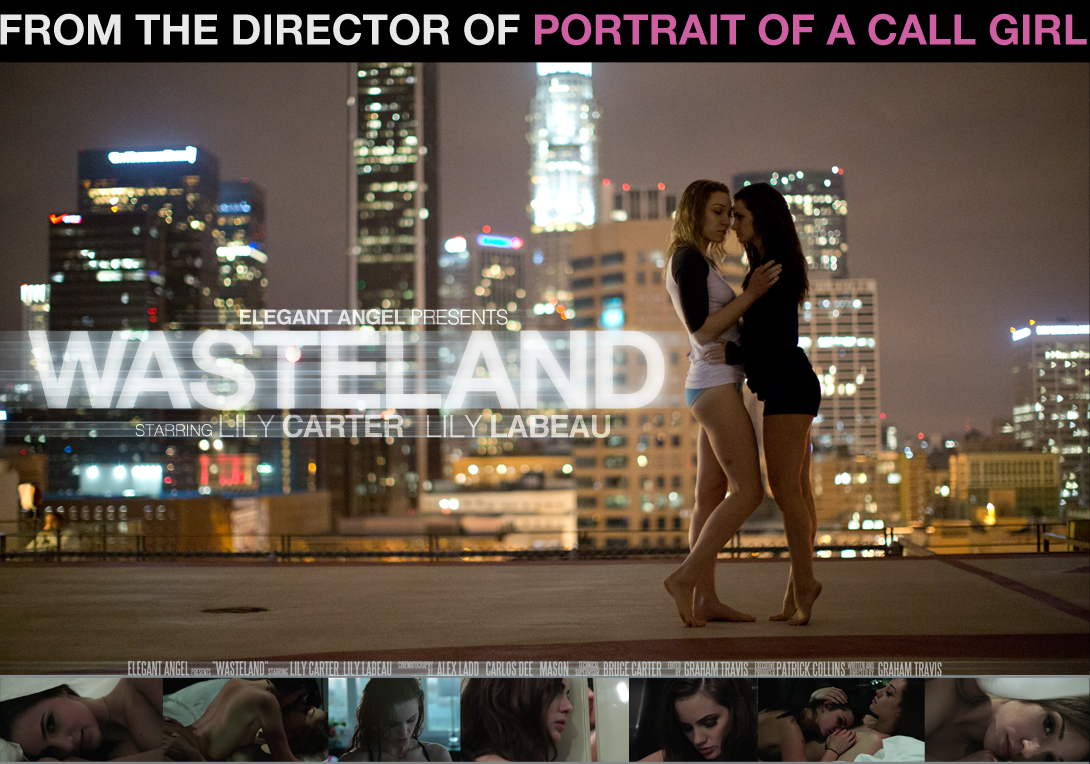
Graham Travis’ Wasteland: the ultimate silence by Anna B. Volk 9.21.12

Poi s’ascose nel foco che gli affina.

Then he hid himself in the fire that purifies them.
- Dante’s Purgatorio, Canto XXVI 148

One can never approach a wasteland with enough caution. The barren and uninteresting panorama is designed to confuse you: it is in the remote maze of a cement jungle that Graham Travis delivers what I assure you to be perhaps the greatest masterpiece of contemporary (adult) cinema. One more exquisite Elegant Angel production, Wasteland revolves around the reunion of Anna and Jacky, old school friends who meet in a Los Angeles which is as deserted as their native Tucson. The movie opens with the following poem:

                         I see a creature, fierce and unrestrained
                         A hazardous raging fire, and yet I reach out towards her flame
                         The darkness from her depths, guiding me into her soul
                         Drawing me into her wasteland… into her world.

Don’t be fooled: it is Anna, and not Jacky, the poem is about. She is the raging fire, the dark one, the wasteland. Her only chance of salvation – to her mind – is through Jacky: aware that, once her grandmother dies, she will no longer have connections with the world, she does not fear what may come of her. What she fears, in reality, is herself: her loneliness, her silence, her depth. Although Anna is completely aware that Jacky does not function as a mirrored representation of herself – she states it in the very beginning, when she says “I met Jacky in high school. We weren’t likely friends. She was popular, outgoing… but unsettled. I was awkward, shy, withdrawn. We were both different. We weren’t like anyone else.” (my emphasis) – she holds on to the fantasy that Jacky is the one person who might prevent her from total isolation and, therefore, a confrontation with her own self.

Lily LaBeau creates an aseptic Jacky who hoovers above sentiments and states that “sometimes I think that there is something wrong with me. Do you ever get that feeling? Like I am not a girl, I’m not a boy, but I am some weird species that is not built like everyone else”. By exempting herself from gender and even from human form, Jacky makes it clear that she is unable to connect with anything – unless when in contact with a parallel sexuality that works as a provocation to sensations and emotions. From the very beginning of the film, the distance she keeps from Anna reflects her knowledge that, deep down, they are so different that they are never going to be able to connect. “She is crazy, this one,” she says at the bar. “You know what they say: it is always the quiet ones.” And although she is the one who seems to be the quiet type, Jacky constantly verbalizes what is actually happening (like when she defines Anna’s promise to always be her friend by defining “always” as “boring, and lonely, and painful, and scary, ‘always’ is just unrealistic”; which is how Anna sees her own future), in contrast to an Anna who reveals things in spurts, but predominantly talks about herself.

Unlike Jacky, however, Anna is not in need of external provocation to feel; on the contrary, she is so constantly tortured by things she does not want to remember that she chooses to focus on specific feelings through life – like her love for Jacky, or the unfamiliar normality of Lee’s house. At the same time, however, she knows Jacky does not belong to her, and she constantly reminds herself of that by choosing to revive in her memory the specific moment in which she realized it; when Jacky has sex with Eric on the night of the campfire, the significance of that moment for Anna lies on her comprehension that Jacky is not able to connect with anyone but on a sexual level, as well as her own inability to do so (“I wouldn’t do the things you would do. I wouldn’t take them on my mouth. Or let them fuck me like a dog”), this way establishing the pivotal difference which separates both women, on her mind. So when she arrives in California she is sure of which path she will take – having spent years romanticizing an adolescence friendship that had left her to deal with her old emptiness when Jacky moved away

“When you left, at first, it was not what I expected. I was so lost. I drank like crazy and listened to songs that reminded me of you. This is embarrassing. I guess I didn’t know what it would be like to lose my best friend. But that empty feeling is normal. You get used to it. The distance grows.” (my emphasis)


Anna departs to Los Angeles despite the imminent death of her grandmother in order to reestablish a non-existing relationship she had been feeding for five years, this way avoiding being disconnected from the world. It is not by chance, therefore, that on her first moments with Jacky, Anna deliberately constructs a revised version of the campfire night, and chooses to watch as Jacky has sex with a man in a bathroom stall. Perhaps in an attempt to breach the distance between them, as a foreshadowing of what is about to come, Jacky invites Anna to partake in her own sexual enterprises by asking Anna to join her and the man in the back alley; however, by transferring sexual completion to Anna’s figure, Jacky is disembodied from her normal role, and the realization that Anna does not configure sex the same way she does hits her before it dawns on Anna or on the viewer, for that matter. Therefore, because she is aware that Anna’s visit is not going to become something permanent, and that Anna is not and will never be like her (despite Anna’s later plea “I want to be like you”), Jacky is able to go through the night without raising expectations and even flashes back in time, becoming a teenager who can play Go Fish and have tequila shots with her bestie: sex for Jacky takes on a calm, tranquil aspect here because it does not represent the provoking kind of sex she seeks in order to feel, but old sensations of friendship and comfort. And that is how she is able to refute Anna’s pledge to be her friend forever, and why she was able to move on after moving from Tucson and missing Anna for “a few weeks” before it “became trivial”.

It is worth noting that all significant moments between the two characters happen around water. From the adolescence lake, to their reunion five years later by the ocean – where both seem tentative and playful facing the water – to the swimming pool scene: those moments are emblematic of female sexuality, and are iconic of the relationship that exists between both women. The counterpart is the fire that burned down Anna’s house and killed her parents; the cigarettes that are lit in the specific moments Jacky is portrayed separated and distant from Anna’s reality; the campfire on the night she sees Jacky and Eric together; the flame-red light at the club when Anna goes through what seems to be an initiation process before she can meet Jacky in the last room. In moments where Anna is confronted with her own fears, the presence of fire undermines that of water, obliterating her sexuality by iron branding her psyche.

Jacky’s wasteland is kept under control although over populated with a myriad of stimuli and several layers of sounds, from dissonant classic music to voices speaking a foreign language; Anna’s, on the other hand, seems placid and silent like the morning after, but poses as a burden heavier to be carried. Unable to make it in Jacky’s world – because it is as foreign to her as the voices that come from the men in the club – Anna returns to the “black hole” of Tucson as empty as she expects her future to be. Her return to Arizona can also be seen as her ultimate redemption: “Then (s)he hid himself in the fire that purifies them.” By returning she is actually walking towards herself, stripped from the (romantic) fantasies towards Jacky she had spent so long harboring. Lily Carter delivers a performance that is impossible to be put into words: she is able to express in her eyes the process in which Anna slowly becomes deprived of life, or gaining conscience that she must ultimately confront herself.

As a writer, Travis is able to implement a variety of foreshadowing elements without destroying the viewer’s hopes – whichever those may be. The impeccable work and careful direction made it possible to extract from LaBeau and Carter deep, genuine performances without forcing them to lose themselves into characters that might differ dramatically from their own personas. Visually the film is potent and impervious, with a cinematography that is heavy and dense even when under white, bright linen. The soundtrack complements the story perfectly, and it should be released as OST.

To conclude, Graham Travis did it again. Wasteland is bound to repeat the same success of Portrait of a Call Girl, but this time with even more maturity and complexity. It will be interesting to see Travis’ next step: topping Wasteland will reveal itself to be a difficult task.


Posted in Homepage-All, review, Uncategorized | Tagged , , , , | 3 Comments

Dear daddy: love, a porn scholar. by Anna B. Volk 8.28.12

This is an open letter I wrote to my father. As an academic himself, he is able to understand my work; as a father, he debates over whether his only daughter should be dealing with “pornography” at “such an early age”.  I hope this helps him understand how deeply rooted within him social prejudices and categorization tools are.  


The academic world seems to think that pornography is too unrefined, too raw, basic, instinctive, too primary and not rational enough for “men and women of letters”. What they fail to see, however, is that any form of art, any format of art as cultural manifestation has per passed pornography at some point in history, be it writing, sculpture, dancing, painting, cinema, music. Yet, pornography is erased from all art forms that involves nudity and sex the minute the academic world requires justification to allow it in: think of Rubens, and his naked chubby ladies, and how we are immediately taught that it is not about nudity and sex, but about female body adoration; Michelangelo’s David and the denial there is any sexual intention in the portrayal of the masculine body, the work being justified as a semi-mathematical ode to human form and proportion; Rodin’s Kiss being deployed of sexual content, explained as belonging to a realm which goes beyond the physical one, at some point even sublimating his relationship to Camille Claudel by restricting it exclusively to the artistic realm. By eliminating pornography from art pieces it becomes acceptable to observe it, to debate it, to enjoy it, because an art which would aim at sexually arousing people is immediately regarded as less valid than arts which appeal to less carnal senses.

Carnal relationships are understood as being less noble than love, spiritual, or even intellectual ones. However, what signifies a relationship that belongs exclusively to one of those spheres to one person, for another might blur boundaries and penetrate more than one of those territories, this way working in double reference and functioning as sexually arousing at the same time that it holds some other significance. For these people – to whom sex and sexual desire are intrinsically connected to other less “mundane” aspects, such as relational skills, intellect, or even religious experiences – to dichotomize sexual arousal from other interests becomes impossible. For these same people, however, the secondary aspect of the artistic intention works as a solvent to the pornographic tone of the artistic matter, if so they wish, and they are able to justify the sexuality in their art under the scope of other sciences.

Sexual art, on the other hand, holds its place inside the academic world as a matter to be approached only under the lenses of other disciplines: sociology, psychology, history, all disciplines can be asked to harbor pornographic art under their scope, if this means securing the place of those works inside the academic debate. Therefore, photographs by Nan Goldin, for example, are constantly justified as being an account of contemporary sexuality, often being taken only as registers of the sexual atmosphere of a certain time and place. Di Cavalcanti’s mulatas are supposed to represent an emerging Brazilian culture, which intentionally promotes the Brazilian woman as a means of reinforcing a national identity. Dash Snow’s “F*** the Police” should represent the ever going clash between power and sex. And, if everything else fails, the naturalist argument that “there is nothing wrong with flesh” comes into action, as to eliminate any underlying meaning of sexual provocation. It is as if the idea of sex or nudity as a sexual arousing tool tinted any art piece, draining its artistic value and relegating it to a category of intentionality that does not comply with that which is expected from the ”fine arts”. After all, art’s objectives should tangent exclusively spiritual elevation, and never, ever inflict body reactions to its observers – or at least not physical reactions which would remind them or their own condition as irrational, impulsive, instinctive animals.

In a Platonic concept of ideal world, where arts is a threat permanently confronted with the necessity to be censored and regulated in order to formulate good citizens – remember, Plato proposed sending poets and playwrights out of his ideal Republic – the state’s interference in artistic endeavors would work more like a tool to eliminate or belittle the power of the arts to influence, and potentially to corrupt. In a Foucauldian analysis of all “neoliberal governmentality” and the institution of inner-regulatory strategies, aligned with the standardization and normatisation of sexuality, sexual acts, expectations, and what is acceptable to desire, would function as a much more solid regulatory tool. In other words, it is by installing a regulatory apparel inside each active citizen that a system is able to secure that any threat is immediately eliminated by the same subjects it intends to corrupt. Therefore, to perpetrate ideas of what is “normal” or “healthy” sexuality and, at the same time, to impose locale in which the expression of sexual desire should be delivered is a way to make sure that people would reprimand any form of artistic expression which does not comply with said rules.

The academic world, therefore, presents itself as a perfect space for the categorization and dissection of erotic and pornographic art, embedded in pseudo-intellectual pre-concepts of what is art and what only mediates social discourse. It is about time the academic community worldwide understands that pornography is as a valid form of art as any other, and the fact it emerges so instinctively to all societies should, alone, advocate for the need of facing pornographic artistic expressions as valid and subject to deep intellectual analysis. Without, I beg, over extending it to find hooks where to peg more moral issues in order to hide it from the faint-hearted.


Posted in Homepage-All, Uncategorized | 3 Comments

Fifty Shades by porn scholar by Anna B. Volk 8.18.12


                                     ‘‘Now punish me!’ she said, turning up her eyes to him with the hopeless defiance of the sparrow’s gaze before its captor twists its neck.  ‘Whip me, crush me; you need not mind those people under the rick! I shall not cry out’. (p. 374)


The quotation above does not belong to any of the three Fifty Shades volumes. Although it has sold over 40 million copies worldwide and stirred debates on the intensity of the sex scenes it depicts, the Fifty Shade Trilogy is being wrongly marketed as “pornography”. Don’t be fooled. There is very little pornography in there.

Disguised under a misused BDSM tag, the Fifty Shades trilogy is nothing but a repetition of the same Victorian romantic paradigms, perpetrated by the Harlequin novels: an unreachable, dark, tense hero who gets rescued by the innocent and true love of a naïve young woman. Damaged Christian Grey is constructed as the combination of a traumatic childhood and sexual abuse suffered at the age of fifteen: his origins are mysterious and dark, locked away behind very little verbal communication with the outside world, his sexual preferences a result of being molested by one of his adoptive mother’s best friend – portrayed as a sexual predator MILF – who still haunts his present days. He is hard, distant, constantly disturbed by his inability to process his feelings, which he then transmutes into successive aseptic relationships with his submissives, none of which has ever slept in his bed. His contractual terms involve providing for and maintaining the perfect mental and physical health of his subjects, void of emotional recognition, and although having been adopted by a cereal-commercial kind of family he keeps them at bay from his own private life, resorting to actually connecting to other human beings exclusively inside his Red Room of Pain, which is kept constantly locked. The heroine, Anastasia Steele, is built under all precincts of romantic female protagonists: she is pure in intention, a virgin, innocent, a literature undergraduate who fails to understand that the main message in Hardy’s Tess of the d’Ubervilles is exactly what she is running towards: Victorian notions of female purity being questioned by the crude analysis and frank look at the sexual hypocrisy of (English) society, and the acknowledgment that the infantilization of women may be even more dangerous than female oppression.

Trapped in the middle ground between the nineteenth and twentieth centuries, Hardy struggled with Victorian ideologies, tradition and innovation. EL James fails to construct a romantic novel because there is no more tradition to fight. In an attempt to recover some ground to establish the battle which would justify or promulgate the romantic aspect of her novel, she turns to the BDSM taboo in a very misleading way, admonishing it from the start: “I’m fully aware this is a dark path I’m leading you down, Anastasia.” (FSOG, 74). What serves as an attraction and explanation to the commercial success of the book does not follow through until the end: loved by Anastasia, Grey subdues to “vanilla sex” in exchange for her presence in his life. The sex scenes depicted in all three novels border Victorian language: James exhaustively insists on the same metaphors for body parts, leaving out what would be considered harsher vocabulary in detriment of a more “romantic” one. “The second and third volumes of the trilogy which, having moved on from the nuts and bolts of dominant-submissive sex, are basically shopping lists”. (WILLIAMS, 08/15/2012) And it is precisely in this dichotomy between what the book promises and what is actually delivered that lays what might be considered the only significant aspect of this market trend: the fact that all the BDSM is eradicated from the novel’s pages almost instantaneously, being replaced by long, repetitive narrative of more conventional sex which, nonetheless, is always practiced under the safe norms and regulations, with Grey producing condoms from his back pocket even if he is not wearing pants.

To be a true romantic novel, what should evolve around the character of Anastasia, mirroring the centrality of the romantic female protagonist is, in James’ book, a failed attempt to focus on the character of Christian Grey. Still, what Millet dubs temperament, or “the formation of human personality along stereotyped lines of sex category ‘masculine’ and ‘feminine’” (MILLET, 1968: p. 26) is so strong within James’ writing that her characters are caricatural, and what should be “based on the needs and values of the dominant group and dictated by what its members cherish in themselves and find convenient in subordinates; aggression, intelligence, force, and efficacy in the male; passivity, ignorance, docility, “virtue” and ineffectuality in the female”. (MILLET, Ibid) is translated into BDSM terminology by an author who, clearly, feared it too much to really dig into this world even if only through her writing.

Although I agree with Hussein’s concept that “reading a text is not an objective process upon which all readers agree. Each reader has certain tendencies and an ideology which s/he imposes on the text itself, rejecting the old approach of text/reader or author/reader hierarchy.” (HUSSEIN, 2004), it is impossible to regard the Fifty Shades trilogy as contemporary pornography or “female-targeted erotica packaged for the mainstream reader” (FORBES, 3/19/2012). Whether by concentrating on the development of literature written by women (gynocriticism) or by reinterpreting various works written by men (feminist critique), feminist literary criticism contests the eternal opposition of biological and aesthetic creativity. James’ does not write the way she does because she is a woman; in 2011, she writes the way she does DESPITE being one. Ignoring Showalter’s classification of women authored literature under the Feminine, the Feminist and the Female stages (SHOWALTER, 1979), James dives back into the past and goes way beyond Hardy’s or even Bronte’s Romanticism, landing flat on a time where language had no significance other than the accurate description, some light years before literature was invented.

It is appalling nonetheless that James’ novels are being regarded as erotica literature. In an Australian newspaper, a journalist wrote that “There is an absence of good erotic writing in serious literature and a puritanical disdain for literary descriptions of sex.” (SIMMONDS, 16/3/2012) I wonder, then, where we should place the works of writers such as Anaïs Nin, Nabokov, D.H. Lawrence, Erica Jong, Henry Miller, Norman Mailer – to name a few. Fifty Shades is being regarded as inaugurating a new found craving for all things ‘naughty in print’ when, in reality, quality literature has been doing it for years, and Harlequin books are not fooling us around, promising BDSM and delivering sparse and condescending use of a few sex toys labeled under poor metaphors for Webber’s herrschaft: “One has to ask if writing about power is always more erotic than writing about penetration.” (MOORE, 7/4/2012)

I refuse to be condescending with James’ work by the use of arguments such as some I have read, that the Fifty Shades trilogy has rekindled marriages and incentive women to explore never-before visited aspects of their sexuality: Sacher-Masoch, Bataille, Catherine Millet and so many others would have done a much better job; even Thomas Hardy, with all the Victorian pressure around him, was able to depict sexuality in a much more palpable way than EL James. “I shall not cry out”, Tess says. Those are Hardy’s words that introduced you to this article. Tess’ eyes are “neither black nor blue nor grey nor violet; rather all these shades together, and a hundred others” (chapter 14). After all, real literature takes more than 50 shades to be good. Luckily for them, “the d’Urberville knights and dames slept on in their tombs unknowing”.


Posted in essay, Homepage-All, Uncategorized | 6 Comments

On Brazilian porn by Anna B. Volk 8.2.12

On Brazilian porn (part 1)

Many thanks to Christian Madsen, without whom this article would still be a draft. 

If you are a woman, just mutter the words “I am Brazilian” and watch as heads turn and people look at you under a different light. There is no escape: Brazilian women are regarded differently from any other nationality when it comes to sex, and the reason does not rest on Brazilian porn. Or does it?


One of the first porn films I watched was one of Buttman’s adventures in Rio. I remember back then – still a teenager and with no idea I would somehow work with the porn industry – to be uncomfortable not with the sex, but with the way Brazilian women were portrayed in the film. The scenes bordered women abuse not in the nature of the sexual content presented, but in the positioning of the performers in relation to each other and to the roles they were developing. There was some kind of veiled violence that had nothing to do with the roughness of the sexual act, but still underlined all movements, utterances, and visual aspects of the film. It looked as if the women were being punished for being Brazilian, as if they were being treated as less than, say, American counterparts would be under the same circumstances.

It wasn’t until I started reading about post colonialism and subaltern colonization that it all made sense to me. Social constructs that go back to the colonial era are strongly influenced by the phallocentric prejudice that classifies “native” women as passive and inferiors. In fact, many of the representations of the female “native” figure in literature and art perpetuate the myth of the erotically overcharged female: the exotic gives room to the erotic, and the unknown, dangerous body represents a threatening jungle that contains too many dark secrets and must be ravished. Add to that the correspondence between the land and the female body – where invading the latter would consolidate conquering the former, a common practice with the invasion of a land eventually leading to the raping of its women – and you have “the parallel between the relationship man-woman and the relationship empire-colony or colonizer-colonized [which] has often been cited in postcolonial theory as well as the “double colonization” of women in colonial situations.” (VIJOEN, 1996).

We must recognize that imperialism is essentially a form of patriarchy that diminishes any opportunity for identity formation in its subjects. In other words, the vertical structure of a patriarchal structure limits action of any Others – women, mostly. However, the subjugation generated in that kind of pornography blurs gender and race borders: it involves both racial inferiority and the belittling of female sexuality. In Gayatri Spivak’s terms, epistemic violence results when in (post)colonial discourse, the subaltern is silenced by both the colonial and indigenous patriarchal power. (SPIVAK, 1992) In the neocolonialism practiced inside the adult industry, the female indigenous body is suppressed by both a masculine and a colonizer’s body; that is to say, the double oppression gender – race places her on the lower hierarchical levels, reducing her to an object which would lose to no other in any rank – not even to the American woman herself.

My question is: WHY does this happen? Is it just a consequence of the economic differences between countries, or is it a result of a way of perceiving sexuality, and mostly, Brazilian female sexuality? Is there any possibility of re-inscription as a subaltern to the female agent, or is she doomed to be under dominance of both male and white race forever? By inhabiting a space which is violent and marked by ultimate physical degradation, could the Brazilian woman speak?

In Foucault’s analysis of power/knowledge dynamics, an episteme consists of the “unitary body of theory” which tends to privilege some knowledges while it subjugates certain others, ranking them low in its hierarchical paradigm. These disqualified knowledges pose challenges to the power and organization of the dominant episteme by claiming attention to their oppositional emergence. As Hayden White, in his interpretation of Foucault’s tropology has explained, the dominant discursive metaphor of a given community determines both “what can be seen” in the world, as well as “what can be known about it”. Therefore, the results of what can be seen and known about the Brazilian woman is filtered through the Eurocentric patrilineal white male eye.

It was, then, epistemic violence what I saw in that Buttman video. The question of epistemic violence is related to issues such as who produces knowledge, or how power and desire appropriate and condition the production of knowledge. The exploitation of the female body as it is constructed by patriarchy, together with patriarchal values aimed at the victimization of women and the destruction of a female sense of selfhood, has led to the double erasure of the female persona in this kind of adult films because it justifies the permanence of established moral codes which, if shaken, might deconstruct not only social but also economic relations. It is, then, reinstating the colonization process by reinforcing the idea of inferiority based on two axes: one, the female identity; the other, the racial/ethnic difference.

But how does all this play out in films produced in Brazil, by Brazilian directors?

Posted in Homepage-All, Uncategorized | 1 Comment

Written on the body

The roof flew from over my house – I have a house in the mountains – and I had to rush there and try to beat the rain. And while I was moving books around, I came across something I wrote when I was fourteen. I was in love then, and the back of my notebooks were filled with initials and hearts and arrows. Among all that, my first attempt to write erotica: only seven lines, scribbled in purple ink, so bold and strong for a fourteen- year-old. But I was in love. And I felt like I could do it.

***

I was too embarrassed to have even written it, though it did give me a sense of power that I had never felt until then. I never showed it to the boy.

***

I am terrible at writing erotica. Throughout my life, because of the nature of the work I do, and my own personal interests, and what I say inside the academic world, I have been invited more than a handful of times to write erotica. I never went through with it. I have turned down anthologies, double spreads, have risked and failed terribly at writing for videos: all because I just cannot find inside me words enough, I tell myself. The descriptiveness needed for erotic writing is an art that I just cannot master: it requires a plethora of vocabulary that I do not possess, structures which I cannot comprehend, and mechanics which are way beyond me.
I am not a good erotica reader, either. Sometimes it is impossible for me to disconnect from the structural part of any writing, and I see myself looking for figures of speech and word repetition and oxymoron. I cringe at redundancies, and that is why I am a terrible erotica reader. Long descriptive lines do not succeed in arousing me, but rather have me building in my head a blueprinted design of how things are supposed to fit together in that given position. I approach erotica with technical glasses and gloves, and both the literate and the architect in me just will not let me enjoy it.


That is why, when I find erotic writing that physically affects me, I fall in love. And this recently happened when I crossed this . I met Liza on Twitter, some joke about being sick and doctor prescribing hotel sex, and it led me to her blog. Maybe she does not even write erotica: maybe she just writes life. But all I can say is that her words have left me speechless and unable to think for some time after I read the first lines. Maybe it is not even a story. Maybe it just happened. All I know is what happened to my body after I was done with her lines. And I fell in love.

***

On the same note, Natasha Gornik always wins me over in a heartbeat: “i want to lick Prague”. If you haven’t read it, you should. It is right here.

***
It is easy for me to write about sexuality and pornography. It is easy to do it, because – if done according to academic standards – there is very little of me I need to put into my work. I have had students inquiring me about my own sexuality and it never surprises me when people are amazed that they cannot grasp ME from my writing. It is academic pornography: in the academic world, the academic has the least important role in the play. We celebrate the work we are studying, its author, its audience. We are always hidden behind quotations and syntaxes. We are even, I dare say, supposed to remain apart from whatever it is we discourse about. Any of our own personal preferences slides inside an article or seminar and we have just put into question everything we have just said. We suppress “in my opinions”, “in my point of views” because we are merely reporting what, yes, we have concluded and, yet, is everything but our own thoughts. That is why I don’t find it strange when people ask me my own sexual orientation, or preferences, or fantasies. I might even give them a direct answer now and then.

***

All this is to explain why I have been MIA from Darling House. I am in love. With a person, with their words, with how things are said to me. But, mostly, I am in love with this whole new world of erotica writing which, slowly and out of necessity, is welcoming me. Maybe nothing will come of it, maybe I just need to go through this scary phase, where I cannot think about anything else. Maybe it is theory coming into practice – and what a frightening thing that is! Maybe it is something more. Maybe. Just bear with me for a little longer: I don’t remember the last time I felt like I was fourteen. And it feels fucking great.

***

The new boy reads my erotica in full. Maybe it is not even erotica. Maybe it will just happen. But it still makes me feel empowered. Even after all these years. The difference is that, now, I write for him to read. And I show it to him: pieces of me, written on my body.


Posted in Uncategorized | 1 Comment

TStimonies: transforming pornographies into historiographies by Anna B. Volk 6/29/12

                           Testimonies are held up as exemplar forms of live that have resisted or transcended the strong arm of domination.

- George Yudice


What happens when porn becomes political discourse? Which mechanisms transform footage into spaces of resistance, belonging, and community? Who are the groups that have taken pornography to another level, registering it as their own site of struggle and social recognition? Once published, whatever path taken by a singular individual is transformed into paradigm inside – and out – the group they belong to. The technical reproducibility of modernity, aligned with an emergence of testimony as a genre of discourse, cast light on social actors who are now protagonist of their own history, albeit once silenced by normative social regulations such as alterity. In Postcolonial times, the Other is in me. And in this forged identity of subaltern and excluded groups, social and economic structures are being transformed.

In a society in which the post-utopic is distopic, marginalized groups must rely on alliances with mainstream and alternative media to attempt at the eradication of stereotypes and prejudices. Their condition as citizens is in itself the questioning of the process of construction of their own identities: to be accepted as social subject, the marginalized must promote a self-displacement that generates a radical change in society’s perspective in order to claim any rights on the construction of their identities. Thus, the creation of an autobiographical discourse must follow strict protocol to be regarded as contemporary testimonies of historic realities. However, when such realities have been written on the body, a shift in strategy must come into action: bodies are now modifiable, generating possibilities of new identity constructions. This new body, in constant mutation, now represents what Stuart Hall dubbed a “mobile celebration” (HALL, 1987): it refutes fixed, essential, permanent identities, being formed and transformed continuously in relation to the ways in which we are represented or challenged in the cultural systems that surround us.

Political contemporary identities are essentially constructed based on gender matters (KRAUSE, 1996). When gender is liquid, it becomes impossible to be contained in one or two receptacles, giving birth to new identities which are as fluid as they are interchangeable. Since a neoliberal politics aiming at inclusive societies would be a contradiction, as the differences which defy the universalization of consumption patterns constitute one of neoliberalism’s most dreaded nightmares, such identities pose as a threat to the maximization of profit, creating new groups of consumption directed at the ratification of such newborn identities. In other words, what Ruth Benedict foresaw becomes reality: the market depends on marginalized groups to form new area of consumption which, by their turn, will demand new products aimed at what they expect to be an inclusive social tool, at the same time that said products solidifies the marginal aspect of such groups and demands.

Nevertheless, some “outcast” groups have found in pornography a way through which they can challenge social stigmas, such as compulsory heterosexualization and binary gender dichotomy. Having operated for ages on the assumption of the existence of two genders and multiple sexualities, the porn industry now faces a plurality of genders being presented not as complementary or secondary identities, but as the core for a large amount of groups and consumers without any hint of the system of punishment and reward expected to be found in stereotypes which are reproduced and repeated. No longer does being “different” mean remaining unknown, secluded, made mute by normative expectations; nor is it to be celebrated as a “positive” mark of difference which, nonetheless, still keeps the different at bay . On the contrary, it is to be dealt with as if there was no difference at all. This identitarian normatization happens not as a result of mainstream oppression, but as a true form of inclusion: by eradicating differentiation strategies, it has become possible to promote “alternative” gender identifications inside the pornographic industry and market it not as different, but as same. The neoliberal dilemma, thus, is solved: these new fluid identities have found a loop hole in the system, and returned to society a product which society is unable to refute as marginal.

And it is under this light that works of artists such as Buck Angel, Nica Noelle’s TransRomantic studio, Loren Rex Cameron, to name a few, have found space inside the pornographic industry to exist without being excluded. Ironically, it was the suppression of the mark which distinguished one group from all others what originated a new space of resistance, inclusion, and valorization of such identities. Not only the porn industry has a lot to gain – and to learn – from the newcomers: society as a whole must understand that different means equal, after all.


Posted in Homepage-All, Uncategorized | 2 Comments