On The Art of The Smack-Down, by Fitzroy

Though the term “smack-down” is a fairly recent addition to the American vernacular, the smack-down itself is of course nothing new. It could even be argued that the smack-down is older than civilization itself, in which case, one has to wonder why it took so long for the term “smack-down” to emerge. Synonyms for it abound and mostly take the form of gerunds (beating, hurting, bruising, etc.), but none of them possesses the satisfying onomatopoetic quality of “smack-down” and no substitute for the word even comes close to its economy and clarity. Describing the outcome of a confrontation as a “crushing defeat” or a “debilitating loss” conveys nothing that “smack-down” does not. It only remains in most cases to clarify who delivered the smack-down and to whom.

It may not be to the credit of men that the smack-down is generally associated with the masculine gender, though I see nothing especially manly in the smack-downs administered in the world of  professional wrestling, from which we inherit the term itself. Personally, I have always been much more impressed with the rhetorical and oratorical smack-down, such as that delivered by Winston Churchill in response to an admonition from his political rival, Bessie Braddock. As the story goes, Churchill encountered Braddock outside the pub in which he had spent the evening drinking and discerning at once that Churchill was intoxicated and eager to upbraid him for it, Braddock remarked, “You, sir, are drunk!” In response, Churchill offered the now legendary riposte, “And you, madam, are ugly. But in the morning, I will be sober.” Oh, snap.

Impressive though Churchill’s rejoinder was, and as much as I admire his wit and pugnacity, the greatest, the smackiest smack-down that I have ever heard takes the form of a closing argument delivered in San Fransisco, California in 1890 in The State of California v. Unknown Defendant.

The attorney who delivered this smack-down nonpareil was none other than the redoubtable Clara Shortridge Foltz. In addition to being California’s first female attorney, Foltz was also the first female deputy district attorney in the United States; the founder and publisher of the San Diego Daily Bee, and New American Woman Magazine; the first woman named director of a major bank; a member of the Bar of New York; a gifted lecturer; a tireless advocate for women’s suffrage; and, a devoted (and single) mother of five children. And she also introduced the idea of the Public Defender. She was, by any standard whatsoever, a total bad-ass. I urge you to read all you can find about this extraordinary woman and then aspire to be more like her. If you can accomplish even a quarter of what she accomplished in her lifetime, you will have achieved much.

By the time of the trial in question, Foltz had been practicing law for ten years and her reputation as an intelligent and capable attorney was well established. Foltz’s reputation, however impressive and well-deserved, was either unknown to or simply ignored by the opposing counsel in the case, a certain Colonel Thetas Stonehill, a former captain in the Confederate army who went by the moniker “Colonel”. Perhaps the good Colonel felt that his case as the prosecuting attorney simply wouldn’t prevail on its own merits, or perhaps he believed that Foltz would simply demure in the face of a direct insult to her and to her sex, but whatever his motivation may have been, he took his summation as an opportunity to deride the reasoning faculties of women in general and to inveigh against Foltz specifically. Addressing the all male jury, Stonehill explained that, “[Foltz] cannot be expected to reason; God Almighty decreed her limitations, but you can reason and you must use your reasoning faculties against this young woman…” And as if the point were somehow in dispute, Stonehill bellowed, “SHE IS A WOMAN!”

The Colonel would find out soon enough that though he had correctly identified Foltz’s gender, he had failed to ascertain something much more important about her: what kind of woman she was. Foltz was the kind of woman who handily out-classed him and readily out-performed him. Superior to him in intellect, character, and much else besides, she was the kind of woman that an arrogant turd like Colonel Stonehill had no business trifling with. The following are excerpts from Clara Shortridge Foltz’s closing argument in the case, in which she immobilizes her opponent on the mat, ascends to the metaphorical top rope of the ring and then delivers the coup de grace in the form of a rhetorical Ram Jam that would incapacitate even the indomitable Hulk Hogan himself. Ladies and gentlemen, one of the greatest smack-downs in the history of the smack-down:

If Your Honor please and gentlemen of the jury:

You well know that I am not before you by my own choice! That in obedience to time-honored rule I am here by order of this court trying as best I can to represent this despairing man. Is it not strange then that the district attorney should make me an object of his displeasure and challenge my presence at this bar because only that I am a woman? The kind indulgence of the court has permitted counsel to range over much matter that is neither of record nor part of the evidence in this case. I would rather the immaterial and irrelevant part of his speech had remained unspoken, for I take no pleasure in the wanton abuse of a jury’s patience nor in burdening them with matter wholly foreign to the case…

Counsel tells you that I am a woman. I wonder that the planets did not stand still in their course and rivers cease to run to the sea at the announcement of this startling discovery. I am amazed that His Honor did not faint upon the bench and that you gentlemen of the jury have survived this awful shock to your nervous systems.

Let me kindly admonish the learned counsel that in a matter of great pith and moment like this he should break the news gently and not plunge such an original thought upon an unprepared jury. A few more such thoughtless revelations and your nervous forces will be destroyed and your reason dethroned. Counsel should beware how he heedlessly enlightens an unprepared jury on such a vital topic.

Again he tells you that I am a woman. By a natural antithesis I presume he would have you infer that he is not. I suppose he wants me to tell you that he is a man and he takes this hurried opportunity and adroit method of testifying to the fact. Though nobody has yet denied it, he seems to be in a fever of anxiety to emphasize that he is a man. I don’t know why he should make such unseemly hast in announcing it. He should remember that a swift and willing witness to a point not controverted is a herald of suspicion. Useless denial has caught more criminals than has silence a long way…

I am that formidable and terrifying object known as a woman—while he is only a poor, helpless, defenseless man, and he wants you to take pity on him and give him a verdict in this case. I sympathize with counsel in his unhappy condition. True, the world is open to him. He is the peer of all men—he can aspire to the highest offices, he can carry a torch over our streets during a political campaign and sell his vote for a dollar and half on election day, and yet he isn’t satisfied. Like Alexander, who wanted more worlds to conquer, he wants verdicts, and in order to awaken your sympathy for him, he tells you that I am a woman and he is only a man.

I confess I do not clearly see the relevancy of the statement to this case. The logic is, I am a woman; therefore, you should find this defendant guilty. The conclusion is rather sudden. We are hurried across the river of dispute without bridge or ferry or fording place. In the chain of his logic an important link seems wanting. There is a weakness somehwere, but mothers are always weak after such extraordinary births, and we presume we ought to be lenient. “Be to his faults a little blind, be to his virtues very kind.”

But counsel insists that I am a woman. Gentlemen of the jury, of the atrocious crime I plead guilty. Into this world I have broght five healthy children. By my industry I have supported them them till some are even now stepping from youth and maidenhood into the broader estate of manhood and womanhood. And I repel the covert slur and innuendo that came with the words, “She is a woman,” words intended to depreciate me and my efforts before you in this cause, words none the less obnoxious because spoken under the cloak of a honeyed compliment. In the name of the mothers who nursed you, and of the wives and maidens who look love into your eyes, I resent this hidden appeal to a supposed prejudice of this jury. I resent this ill-concealed slur and covert innuendo that the presence of a woman in a lawsuit contaminates her and that her sex must militate against her client…

Counsel intimates with a curl on his lip that I am called the lady lawyer. I am sorry I cannot return the compliment, but I cannot. I never heard anybody call him any kind of lawyer at all.

And now let us take it all together. I am a woman and I am a lawyer—and what of it? It is not so new or wonderful a thing. I am practicing law in this city; I have offices in one of its largest buildings, and I go daily to and from those offices in my right mind. I am certainly not unknown to the bench and bar of California. And gentlemen, I came into the practice of my profession under the laws of this state, regularly and honestly, and not by the certificate of another state that required no learning to secure, and I have come to stay. I am neither to be bullied out or worn out. I ask no special privileges and expect no favors, but I think it only fair that those who have had better opportunities than I, who have had fewer obstacles to surmount and fewer difficulties to contend with should meet me on even ground, upon the merits of the law and fact without this everlasting and incessant reference to sex—reference that in its very nature is uncalled for and is as unprofessional as it is unmanly…

Counsel thought I was too timid to resent this miserable inference against women in courts of justice. I am descended from the heroic stock Daniel Boone, and never shrunk from contest nor knew a fear. I inherit no drop of craven blood. If I have remained silent when others would have retorted, it is because of my respect for the courts and the halls of justice, which I grieve to see become the arena of personal encounter. But the patience which at first may have been a virtue would become criminal by longer exercise. This controversy was not of my seeking—a long series of abuses has forced it upon me.

When I so forget the dignity of my profession, when I so trample upon its courtesy, when I so shut my eyes to the honor and respect due this bench as to introduce such irrelevant matter, I hope that I may be barred the profession and banished the country.

Sources:
Ladies and Gentlemen of The Jury: The Greatest Closing Arguments in Modern Law
http://en.wikipedia.org/wiki/Clara_S._Foltz

Posted in Homepage-All, Uncategorized | Tagged , , , , , | Leave a comment

New Years Revolution: Zuccotti Park (temporarily) Reclaimed , by Eric Walton

In many but not all senses of the word, the Occupy movement is at war. As I see it, it’s a war primarily of values and ideas against institutionalized inequality, corruption, and injustice, but in some respects and certainly on some occasions, it’s also a war both for and about territory; and the locus of that aspect of the struggle is beyond any doubt Zuccotti Park –also known as Liberty Plaza– in downtown Manhattan.

Hundreds of Occupy Wall Street activists were only days away from celebrating the two-month anniversary of the occupation of Zuccotti Park when Mayor Bloomberg deployed the NYPD to clear the park in what can only be called a para-military raid, undertaken in a media black-out in the early morning hours of November 15th. Over five-thousand books and much personal property were destroyed in the raid and most of the other major Occupy encampments throughout the country, including Oakland, Philadelphia, and Los Angeles, were evicted within weeks. In its battle for territory, the Occupy movement had suffered an enormous setback.

But last night, 31 December, 2011, the Occupiers could relish a major, if short-lived, victory in their territorial struggle. Protesters and revelers at Occupy 2012: Wall Street New Years Eve Celebration wrested many of the steel barricades that had been placed around Zuccotti Park after the eviction and had surrounded it ever since, from the perimeter and threw them into a huge pile in the middle of the plaza. The police, many of them clad in riot gear, were greatly out-numbered and handily out-maneuvered by the protesters, and even their pepper-spray, which they discharged into the face of more than one protester, failed to give them a tactical advantage sufficient to overcome the crowd or prevent the victory pile of steel barriers from growing larger.

Once the mountain of barricades was complete, some of the protesters climbed triumphantly on top of it with banners and an American flag, while others decorated it with Christmas lights and yellow and black Occupy caution tape. Unsurprisingly, a vibrant and ecstatic drum circle quickly followed.

At around 1:00 a.m., dozens of police officers began to converge on the north side of the park and at about 1:30, many of them entered it with riot-cuffs, batons, and helmets and began to make arrests. Two police officers forced a young Hispanic man against a tree and as he was being hand-cuffed he shouted, “Can you tell me why I’m being arrested?! What am I being charged with?” As he was led to a police van, many protesters asked him his name. He yelled in response, “Angel Rodriguez!” In total, sixty-eight people were arrested.

Once police had cleared the park by either arresting or threatening to arrest anyone present, they were joined by a group of men and women (presumably employees of Brookfield Properties, which “owns” and maintains Zuccotti Park) and began dismantling the pile of barricades in the center of the plaza and re-placing them around the perimeter. The last thing I heard as I left Liberty Plaza early this morning was the loud and triumphant declaration of a man who had been supplying pizza to the protesters throughout the celebration. Addressing a group of police officers who were escorting us off the sidewalk and away from the park, he shouted, “We won this battle! You may win the next one, but this one was ours!”

Posted in Homepage-All, Uncategorized | Tagged , , , , , , , | Leave a comment

Happy Birthday, Houdini by Fitzroy

(published March 28, 2011)

“The three most famous names in history are Jesus Christ, Sherlock Holmes and Harry Houdini.”

-George Bernard Shaw

As the terrestrial existence of Jesus Christ is a matter of some dispute among professional historians, and as there is no question that Sherlock Holmes was entirely fictitious, then at least as far as George Bernard Shaw is concerned, the most famous name of any person in verifiable history is that of the master escapologist and showman, Harry Houdini, whose 137th birthday was (rather, would have been) last Thursday, March 24th.

In honor of the auspicious occasion of Houdini’s birth, it seemed only fitting that I should compose a haiku:

Harry Houdini:

Showman, conjurer, icon.

Bondage fetishist?

Now, as a professional escapologist and conjurer myself, and as one who is therefore deeply indebted to the late, great Harry Houdini, a single haiku seemed like too meager a tribute, so in the spirit of homage, veneration and cross-dressing, I offer the following photographs, which I took last week during a Houdini-inspired photo shoot.     

I hope you enjoy them.    

Posted in Homepage-All, Photos | Tagged , , , | 1 Comment

An Early Education

“Gullibility and credulity are considered undesirable qualities in every department of human life — except religion.” -Christopher Hitchens, author and journalist (b. 1949)

It is inconceivable that I could have reached the age of twelve without being lied to. I had, after all, not been raised in isolation from other human beings. And as I reflect on it now, it seems altogether implausible that I would not have recognized the perpetrators of at least some of these inevitable falsehoods for what they were and called them out on their lies. It seems implausible, that is, until I consider that as a child I was both extremely credulous and incredibly timid. I was, in the parlance of the midway, an “easy mark”. My childhood timidity, credulity, and tractability also made me an excellent target for religious inculcation, but I’ll grind that ax another time.

The very first occasion on which I can recall another person telling me something that I knew to be utterly false and on which I marshaled the courage to confront the liar with the known facts, was, fittingly, on the midway.

The midway in question was at the Oklahoma State Fair, an annual gathering in Oklahoma City of corn-dog, funnel cake, and cotton candy vendors; trinket peddlers; mechanical bull, thrill-ride, and sideshow operators; Alibi agents; lot lice; Flatties; townies; and, rubes like me who just couldn’t wait to be separated from their hard-earned cash.

Only on a dare or when facing the prospect of starvation, should any sensible person who has reached the age of majority eat a funnel cake.

One of the many sideshow attractions on offer at the Oklahoma City fairgrounds in the summer of 1983 was A GIANT ALLIGATOR!!! MEASURING OVER TEN FEET IN LENGTH AND WEIGHING MORE THAN 800 POUNDS, THIS ENORMOUS AND TERRIFYING, MAN-EATING MONSTER WAS CAPTURED IN THE AMAZON AND IS ON DISPLAY NOW, ALIVE AND ON THE INSIDE!!!

Or words to that effect.

As anyone who has ever visited the midway knows, for attractions such as these, the bally often isn’t delivered live, but is pre-recorded and played in a constant loop over a PA system that invariably sounds as if someone had simply placed a bull-horn in front of a gramophone.

The quality of the PA system notwithstanding, I was powerless to resist the hypnotic spiel that promised a rare glimpse of a powerful and prehistoric animal, the likes of which I had only seen on Mutual of Omaha’s Wild Kingdom. I paid the price of admission to the attendant, a man in his mid-forties with the leathery skin and cynical demeanor that is either the product of or pre-condition for life on the midway, and ascended the platform to see THE RARE, EXOTIC, AND DANGEROUS CREATURE THAT COULD SWALLOW A GOAT ALIVE!!!

I will now tell you what you undoubtedly already know: the alligator was not real. It was a fake. And a shoddy one, at that. The only claim made regarding this attraction that was not completely false was the one regarding its length: it was, by my best reckoning, approximately twice as long as I was tall, making it indeed ten feet long or thereabouts, but otherwise, every word used to describe what was obviously a cheap, plastic simulacrum of an alligator was unquestionably false. I suppose it can be granted that it was “enormous” and “on display”, as stated in the extravagant and misleading description, but it was nonetheless a gross and fraudulent mischaracterization of the attraction and I felt, for the first time, that I had been duped (which I had).

I then had the following exchange with The Man With The Leathery Skin:

Me: Um, sir, that’s not a real alligator.
The Man With The Leathery Skin: Yes, it is.
Me: No, it isn’t. It’s fake. It’s totally fake. It’s not even moving. Not even its eyes are moving.
The Man With The Leathery Skin: Just cuz it ain’t movin’ don’t mean it ain’t real. Don’t you sit still sometimes?
Me: Yes, but…
The Man With The Leathery Skin: Well then, there ya go!
Me: Some of the paint is even chipped off of it. Why would you ever need to paint a real alligator? Under what circumstances would you need to paint a real alligator?
The Man With The Leathery Skin: Listen, son: if that alligator was fake, I would have the Oklahoma City police department on my case like white on rice, but I don’t see no police around here, do you?
Me: No, but..
The Man With The Leathery Skin: Well then, there ya go!

Or words to that effect.

A clean midway is a happy midway! (Disclaimer: To the best of my knowledge, the folks at Blue Sky Amusements are upstanding business persons and have never claimed that a bogus alligator is a real one.)

I asked for a refund and was (it will come as no surprise) rebuffed. Never again would I see the two quarters that I had eagerly surrendered to The Man With The Leathery Skin only moments prior in exchange for the privilege of looking at a phoney alligator in a shallow pool of murky water. Oh, the injustice! But if attractions like these gave refunds to every man, woman, or child with enough sense to distinguish a plastic alligator from a real one, it would make the sideshow a very poor business model indeed. I do not, however, regret the expenditure or the experience, as it marks my first exposure to several aspects of human nature that I have encountered numberless times since and against which I constantly arm myself — the foremost of which being the willingness of some persons to stake their credibility on claims that they know to be both patently false and easily disproved. “How fascinating,” I thought.

And thus were the seeds of skepticism sown in my boyhood mind. It would take several years and much careful tending for those seeds to bear fruit, but bear fruit, they did.

Perhaps it can be said that I owe something to The Man With The Leathery Skin, though that something is certainly not my gratitude. He had no intention other than to lure me and others like me into his ramshackle exhibit under false pretenses and take our money – to enrich himself (albeit slowly) by exploiting the gullibility of strangers. To say that I should be grateful for the man’s fraudulence and conniving would be absurd; but as he was, in his own subversive way, instrumental in my early education, I suppose I do owe him something.

And as he doesn’t deserve my thanks and already has my money, perhaps I could offer him something of even greater value: A RARE GLIMPSE OF THE ELUSIVE HIMALAYAN ALBINO TIGRESS!!! THIS AMAZING CREATURE HAS TO BE SEEN TO BE BELIEVED!!! WITH FUR THE COLOR OF PURE ALABASTER, THIS MAGNIFICENT AND FEROCIOUS ANIMAL IS A WONDER TO BEHOLD!!! STEP RIGHT UP, SIR, AND MARVEL AT THE MAJESTY OF NATURE…

Text and photos © Eric Walton, 2011

Further reading: Eyeing The Flash: The Making of a Carnival Con Artist by Peter Fenton (Simon and Schuster, 2005)


Posted in Uncategorized | Tagged , , | 1 Comment

The Amazing Tattooed Women!

In the 1881 autobiographical booklet The Life and Adventures of Capt. Costentenus, the author gives a harrowing account of how his body came to be covered from head to toe in nearly four-hundred elaborate Burmese tattoos. It seems that after many incredible adventures throughout the Near and Far East, Captain Costentenus was laboring in a copper mine in China and along with two of his fellow miners, organized a worker’s uprising which ultimately put him at the mercy of the local sovereign, Yakoob Beg, Khan of Kashagar. The pitiless Yakoob offered Costentenus and his conspirators a choice of six grisly punishments and one that really doesn’t sound that bad: “You may be starved to death, stung to death by wasps, killed by tigers, cut to pieces–beginning at the toes–impaled on spears, burned to death, or tattooed. If you survive the last, the Khan will give you your liberty.”

According to Costentenus, he and his companions decided that tattooing was preferable to death by wasps, tigers, spears, starvation, fire or being cut to pieces. And though Costentenus survived the ordeal, the same cannot be said for his less stalwart companions, who allegedly died (and presumably in terrible agony) in the course of the tattooing sessions. Apparently health code regulations regarding body modification were virtually non-existent and very loosely enforced in late nineteenth century China.

After three excruciating months at the hands of Yakoob’s merciless tattoo artists, the brave Costentenus supposedly killed one of the Khan’s men, was sold to a Turk who put him up for auction at a slave bazaar, and was purchased by a wealthy American whose riches were “gained in the show business.”

Thus began the good captain’s illustrious career in the freak show as a “living picture gallery”.

A full color pitch card for Captain Constentenus, The Tattooed Prince

Of course, only the most credulous twenty-first century reader can believe Captain Costentenus’s account. The tale is so fraught with implausible circumstances and unlikely characters that it’s impossible to regard it as anything more than the ornate fabrication of a flamboyant opportunist. But his story and others like it help account for the modern Western attitude toward and fascination with tattoos. They’re often seen as exotic, primal, atavistic and a hallmark of the rebellious, the fringe and the disenfranchised. To quote the Italian scientist Cesare Lombroso, “Tattooing is in fact one of the essential characteristics of primitive man and men who still live in a savage state.”

Lombroso wrote that in 1896, so we have no way of knowing if he intended his statement to apply to the millions of twenty-first century women whose lower backs would later be adorned with so-called “tramp stamps” or the countless other “savages” whose petite ankles would be graced with delicate daisy chains or tiny four-leaf clovers, but I think it’s safe to assume that he would have taken a rather dim view of all such markings, no matter how modest (or inane).

Over the past two years, I’ve had the great fortune of photographing a number of beautiful women with many gorgeous tattoos. None can compete with Costentenus in terms of total coverage or sheer audacity, but as far as I am aware, none of them are trying. And unlike Lombroso, I wouldn’t dare classify any of these women as savages, or even aspiring savages (though one of them did once express her intention to become a full-time hobo).

When I look at these women and the beautiful artwork on their skin, I can’t help thinking that the act of getting inked is indeed an act of rebellion, but not in a William Wallace kind of way. I believe (and I don’t presume to speak on behalf of anyone pictured here, or indeed, anyone pictured anywhere) that getting tattooed is a woman’s way of asserting ownership over her own body. And given the disproportionate and disconcerting influence of politicians who go to increasingly appalling lengths to limit a woman’s right to choose what she may or may not do to her own body, I see tattoos on women as an act of defiance, a political statement that she and no one else is sovereign over her own body.

And to be fair, I also see tattoos on women as an opportunity to make pretty pictures.

Enjoy.

Darling House's own Savannah D

She goes by "Kitty" and has (if I'm not mistaken) four of the seven deadly sins represented on various parts of her body, as well as much, much else.

The gorgeous and ornate Vivian Galloway whose many tattoos include the likeness of Felix The Cat

The incomparable Madame Rosebud of Darling House

Megan has a beautiful tattoo of a woman on her right arm, as well as an owl and a raven elsewhere on her person.

Succor Suicide was a pleasure to shoot with and has a tattoo of a Dali painting on her right arm.

The aforementioned tattoo of a raven

Buried in Kitty's cleavage is a tattoo of a skull.

Savannah D is stunning and I defy anyone to say otherwise.

Sources:

Freak Show by Robert Bogdan, The University of Chicago Press (1988)

http://thehumanmarvels.com/

Posted in Uncategorized | Tagged , , , , , , , | Leave a comment

This is Your Brain on Card Tricks

It is no secret that magic is an art-form based largely upon secrets – secret moves, secret apparatus, secret intentions. If the presentation of magic is to be successful, the magician must know something that the spectator does not and he must keep that something a secret for as long as he can.

But a secret isn’t the same as a lie.

A lie is the deliberate misrepresentation of the truth, perpetrated in order to gain some advantage, generally a malicious one. A lie is always told with the intent to deceive, whereas a secret is merely the concealment of the truth or some aspect of it and may or may not involve the will to mislead. I may have a secret tattoo of Genghis Khan on the sole of my foot, but you are unlikely to consider yourself deceived if I fail to disclose the fact when we first meet.

Maybe I have a tattoo of Genghis Kahn on the sole of my foot and maybe I do not. Is it such a big deal either way? Not really.

And while we magicians must sometimes resort to overt lying in order to present our tricks successfully, most of the deception on which we rely is not in the form of lies that we tell our audiences, but in the fabrications and confabulations that take place within the minds of the spectators themselves. By carefully manipulating the sensory data available to his audience, the magician orchestrates a series of “experiential voids” which the spectator (consciously and unconsciously) fills with his own expectations, assumptions and interpretations. Thus, the spectator is not so much the victim of the magician’s deception, as he is both a witting and unwitting accomplice in it.

The unconcious act of filling in experiential voids and sensory blanks to create a full experience of the world is known as “schema-driven” or “top-down” processing and is the brain’s attempt to create a comprehensive picture of the world around it, often based on very little sensory information. A commonly cited example is that of seeing a cat behind a picket fence. Though much of the cat’s body is obscured by the fence, the brain doesn’t assume that those parts of the animal are simply missing. It fills in the blanks based on its many previous experiences with cats and fences and constructs a picture of an entire animal and not a Dali-esque version of one.

What every good magician understands is that the act of perception is also an act of imagination; and that the information he gives to his spectators – visual, auditory and otherwise – is fraught with associations and expectations that have formed over the course of a lifetime of experience and will almost always be interpreted in a way that is consistent with that experience.

Specifically, the magician understands that within the spectator’s mind (as in his own) a causal relationship between events has been established; and given or denied the appropriate stimuli, the spectator will automatically and unconsciously impose that causal relationship upon everything he sees and hears.

He will quite naturally expect that if he knocks a butter-knife off the table, it will inevitably fall to the floor. His experience of the world has imprinted on his mind the inescapable link between falling off the table and landing on the floor. And if, a fraction of a second after the knife falls, what he hears is not the familiar sound of metal hitting the ground, but the sound of a startled dog, he will not (if he is sane) assume that the knife has magically transformed into a dog, but rather that it landed on the hapless animal who happened to be in the wrong place at the wrong time.

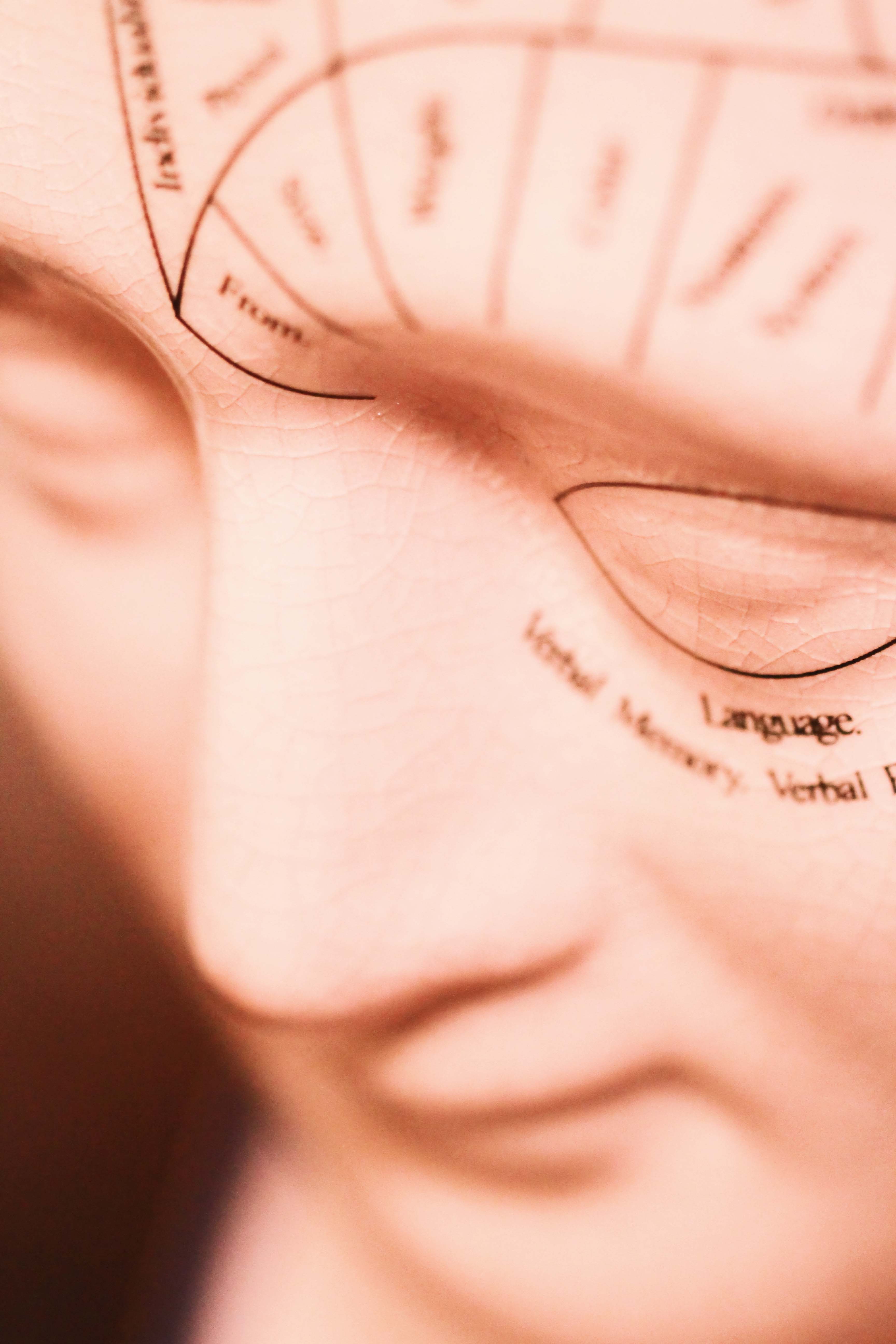
I include this photograph of a phrenology model because no article about the brain, perception and magic would be complete without one.

Our brains (with some unfortunate exceptions) have not evolved to expect extraordinary explanations when ordinary ones will do. It is the task of the competent conjuror to eliminate the ordinary explanations until only the extraordinary explanation remains. And this we do not by fooling the senses, but by inducing the imaginations of our audiences to fill the sensory gaps left by our carefully choreographed actions.

Thus, it is both inaccurate and misleading to say that the magician has fooled your eyes. In order to fool your eyes, I would have to alter the way photons of light fall on your retinas, a feat of which I am hardly capable. A much more interesting and satisfying and exciting task is to compel the imagination of the spectator to fill in the blanks I have left in a way that is consistent with my intentions and my narrative and to induce him to complete a familiar story from which certain passages have been deliberately omitted.

As Shakespeare wrote in (an early, unpublished draft of) Julius Caesar, “The fault, dear Brutus, lies not in our visual cortices, but in our reliance on top-down processing.”

————————————————————————————————————————————————
This post was originally published on February 16th, 2011 as “The Role of Imagination in Magic” on the Lincoln Center Institute’s Imagination Now blog. I’ve made some minor revisions to that draft because it’s my blog and I can do pretty much whatever I want.

Further reading:

Proust Was a Neuroscientist
Imagination First: Unlocking The Power of Possibility
The Brain That Changes Itself
The Oxford Companion to The MInd

© 2011 Text and phrenology photo by Eric Walton. Photo of Genghis Kahn from here.

Posted in Uncategorized | Tagged , , , , | 3 Comments

Marcel Proust Post

By Eric Walton

A few weeks ago, I stumbled across a portrait of the famous nineteenth-century French novelist Marcel Proust by the equally French painter Jacques-Emile Blanche. Though I was looking at only a small, black and white reproduction of it in a paper-back book, I found the portrait quite arresting: the expression of worldliness and fatigue in Proust’s eyes; the dark, open lips; the elegant Victorian attire; and, the way Proust’s face seemed to emerge, specter-like, from the back-ground all gave the portrait a grave, ethereal quality that I found (and continue to find) captivating.

Portrait of Marcel Proust (1871-1922) by Jacques-Emile Blanche (1861-1942)


Fairly certain that Blanche wouldn’t mind, I decided to take a photographic portrait inspired by his famous painting of Proust. I suggested the idea to a model named Claudia, whom I slightly knew, and she readily agreed to pose as the novelist. I was both impressed with and grateful for Claudia’s willingness to help me bring the idea about and I think you will agree that she did a smashing job channeling the redoubtable and instructable Proust.

Portrait of Claudia Kiss by Eric Walton (July 17th, 2010) © 2010

Posted in Uncategorized | Leave a comment

Social Decorum and Sustainability: One Vegan’s Quest Not to Sound Like a Self-Righteous Bore

By Eric Walton

Twenty years is a long time to do something; and it’s also a long time not to do something. In just a few months it will have been twenty years since I last ate any form of meat, eggs or dairy and despite the nearly two decades of experience in the matter, when asked to explain why I am a vegan, I’m nearly always stymied by the question. Not because I don’t have plenty of good reasons for not eating animals and the food made from them, but because I know that giving anything like a complete answer will often result in terrible awkwardness.

For instance, I sometimes give this pithy answer that only partially accounts for my decision to abstain from animal foods: “I don’t eat animals because I believe in compassion more than I like the taste of muscles and organs.” And true though that is, it always sounds sanctimonious and preachy. I realize that I have no reason to apologize for the moral clarity I feel on this issue, but nonetheless, I’d rather not sound like a sententious prick to someone who’s just asking a polite question.

Still other times someone will ask why I’m a vegan and I’ll respond with the somewhat more ambiguous answer that, “It’s for ethical as well as environmental reasons.” This will sometimes allow me to expatiate briefly on the demonstrable links between a meat-based diet and deforestation; water-shortages; desertification; top-soil erosion and water and air pollution. And though these are also perfectly legitimate and sensible reasons for eating low on the food-chain, who wants to ruin someone else’s otherwise happy meal by confronting him with the damage done to the planet just so he could eat it? I’ll tell you who: party-poopers.

In the U.S. alone, over 260,000,000 acres of forest have been converted to cropland to grow feed for farm animals.

When I’m feeling especially indignant about the state of the world and the social injustice and economic disparity with which a meat-based diet is inextricably linked, I’ll sometimes reply to the curious that I’m a vegan for political reasons, that I find it unconscionable that over half the world’s grains are fed to livestock, while 16,000 children starve to death on this planet every twenty-four hours; and that is to say nothing of the 84,000 adults who suffer the same hideous fate every single day, in part because the grains that could have been used as sustenance for them are instead being fed to cows, pigs and chickens. Believe me when I tell you that introducing that little bit of trivia into the conversation is the perfect way to get yourself crossed right off the guest-list.

And on those occasions on which I’m feeling particularly philosophical (as is often the case) and am in the company of those who seem to be of like mind (as is seldom the case), I may invoke Kant’s Categorical Imperative and state solemnly that in sparing the lives of animals and showing solidarity with the world’s needy and hungry by eating a diet that doesn’t deprive them of the means to feed themselves and their families, I am acting, “according to that maxim whereby I can at the same time will that my actions should become a universal law.” Of course, when in a Thoreauvian state of mind, I may explain that though I am not bound to devote myself to the eradication of any evil, I am obliged to wash my hands of it and lend it no practical support. I cannot tell you the number of friends of I have won with that bit of rhetoric.

An adult pig has cognitive abilities comparable to those of a three year-old human child.

Socially speaking, certainly the most palatable reason one can offer for being a vegan or vegetarian is simply that it is healthy. Given the amount of research that has been done on the subject and the ready access to information that we in the 21st century enjoy, many people already know that compared to meat-eaters, vegetarians not only live, on average, six to ten years longer and are fifty percent less likely to develop heart disease, but also tend to have lower body mass indexes; lower blood pressure; lower blood cholesterol levels as well as lower rates of hypertension, type 2 diabetes and colon and prostate cancers. And, as vegans Natalie Portman and Alicia Silverstone can attest, it helps keep you skinny. Not surprisingly, the most solipsistic reasons for being a vegan can be the most agreeable to many people in our image-obsessed culture. Perhaps for this reason, I am almost never content to defend the vegan diet on the basis of its health benefits alone, even when doing so might bring relief to the poor sod who had the impertinence to inquire about it.

As the 40th anniversary of Earth Day approaches, as the connection between diet and the environment becomes more and more demonstrable and as climate-change threatens to imperil the future of our own species and many, many others, I am compelled (nay, obliged!) to answer the question “Why are you a vegan?” with a truth so inconvenient that even the venerable Al Gore is (so far) reluctant to mention it: the vegan diet combats global-warming.

Consider:

*The production of just one pound of beef creates as much greenhouse gas as driving an SUV forty miles.
*Following a vegan diet decreases your carbon footprint by fifty percent more than switching to a hybrid car; and for every person who follows a vegan diet, one acre of trees is spared each year.
*According to Goveg.com, “In the U.S., seventy percent of all grains, eighty percent of all agricultural land, half of all water resources, and one-third of all fossil fuels are used to raise animals for food.”

*A study at the University of Chicago concluded that if every American had just onemeat-free day per week, it would be the equivalent of taking 8,000,000 cars off the road.

“Okay, I give up; where’d you put the glacier? Seriously, guys, where is it? Guys? Guys?”

Given the clear and unequivocal evidence of the connection between meat-production and global-warming, it is, I believe, a matter of great moral urgency to inform those who will listen of that connection, regardless of the social stigmas that may result. However, as everything is more pleasant when delivered in rhyme, I have composed the following Limerick to help soften the blow:

As you sit serenely devouring your steak medium-rare,
I would indeed be remiss not to tell you, “Beware,
Of the horrible things that brought that meat to your fork,
(And the same applies, I might add, to fish, fowl and pork);
And, incidentally, you’re wounding the planet, perhaps beyond repair.”

© 2010 Eric Walton

Sources:

*G Eshel and PA Martin, “Diet, energy, and global warming,” Earth Interactions 10, Paper No. 9 (2006): 1-17. www.census.gov/main/www/popclock.html and www.fightglobalwarming.com/page.cfm?tagID=263

*http://en.wikipedia.org/wiki/Starvation

*H. Steinfeld et al., Livestock’s Long Shadow: Environmental Issues and Options, Livestock, Environment and Development (2006).

*NewScientist.com, “It’s Better to Green Your Diet Than Your Car,” 17 Dec. 2005.

*Andrew Pierce, “Global Warming Is Mankind’s Greatest Challenge, Says Prince,” The Times 28 Oct. 2005.

*http://www.goveg.com/environment-globalwarming.asp

*Diet For A New America by John Robbins, Stillpoint Publishing (1987)

Posted in Photos, Uncategorized, Videos | Tagged , , , , | 4 Comments

Hello world!

Welcome to House of Darling Sites. This is your first post. Edit or delete it, then start blogging!

Posted in Uncategorized | Leave a comment