Pipes of Pandrogeny, by Bastard Keith


The two gentlemen in the row behind me had absolutely no idea what the film was about.  They nattered pleasantly about art, residences both here in New York and abroad, and about the meaning of “swag” as used by one of their younger students, but the dapper fifty-something queens eventually began wondering what screening, exactly, they had decided to drop in on.  I turned to them as they voiced their confusion and explained, “Well, it’s about an industrial music star and his dominatrix wife, who underwent plastic surgeries to look more and more like each other.”

They clutched their French Institute monthly guides and pursed their lips.  “Oh, MY.  Really?”

“Really.”

They looked both scandalized and pleased.  I never got to check in with them after the screening, but I hope they enjoyed The Ballad of Genesis and Lady Jaye as much as I did.  As portraits of transcendent love, Marie Losier’s documentary has few equals.  How could it?  Have you ever heard a story like it?

Shot largely on grainy, hand-cranked cameras, The Ballad of Genesis and Lady Jaye is in no sense a conventional documentary.  It operates more like an organic memory, comprised of equal parts the mundane, the bizarre, the ethereal and the digressive.  Much of it is montage, though sometimes narration helps us along.  It only really takes a narrative shape occasionally.  And yet perhaps this was the perfect way to capture a romance so idiosyncratic that nothing short of entering the heads of the people involved could do it justice.

Genesis P-orridge (born Neil Andrew Megson) is perhaps best known as the bomb-thrower behind Throbbing Gristle and Psychic TV, a musician and performance artist of virtuosic and sometimes daunting eccentricity.  Ballad presents Gen (as we soon come to know him/her/them) as something of a goofball wizard, sometimes doing silly little dances, sometimes creating genuinely extraordinary noises, sometimes pottering around doing the housework.  Occasionally we get glimpses of Gen’s past life, screaming at adoring audiences and urinating into bottles on camera.  A portrait emerges of the artist as misfit, a boy never quite comfortable in one place or body.  Indeed, the dominant motif of the film is Gen running in circles, and that’s where she seems happiest, glad to be exhausted and giddy.

Though the film gives us a terrific amount of backstory and archival footage for Gen (we glimpse an archive room that stretches on and on in which Gen’s life and career are obsessively catalogued), Jaye’s life is no less interesting.  A professional domme in her mid-teens, she became a performance art fixture downtown, and we see glitched video of her appearances, which take on fetish and gender concerns.  We come to realize that the yearning to escape the constraints of convention, expectation and biology are not exclusively Gen’s.  And it is this aching frustration with the inadequacies of the corporeal which forms the backbone of their strange, touching bond.

Gen and Jaye’s story begins with a meet-cute of sorts: the middle-aged Gen is sleeping on the floor of a friend’s dungeon, covered head to toe in a sheet and lying stiff and flat as a board, when in walks a young woman, Jaye, in perfect 60s clothing.  Gen watches as she changes into strict fetish gear and marvels that someone could so ideally embody “my two favorite things.”  Shortly thereafter, romance sparks up and marriage is soon to follow.

The conversation determining the course of their relationship is recalled rather sweetly.  “Instead of having children, what if we made ourselves the new person?”  And so they do.  Through a number of procedures (breast implants, facial restructuring and more) the two lovers consume each other, vanishing into their shared identity as Genesis Breyer P-orridge.

Losier doesn’t even try to simplify the complex issues at play here.  Pandrogeny is talked of at length, the movement to transcend DNA to create a perfect hermaphroditic state.  This is probably the film’s most revolutionary strand.  Where some would paint this as the story of a man undergoing a sex change, Losier accurately and with great artistry makes us understand that what we’re watching is two souls merging into one.  This is what people talk about figuratively when they speak of romance, but how many of us would be willing to go to the lengths that Gen and Jaye did?  How many of us would willingly sacrifice our individuality in the service of love?  If we assume that two souls occupy the same space when entwined in love, is it not possible for two bodies to do the same?  How important is it that we hold on to the bodies we take for granted?  Some people seek to obliterate the cage of the physical through BDSM, some through drag, some through transsexuality.  Gen cites the work of Burroughs and Gysin as an inspiration.  Life is a collage: cut it up and rearrange it and it’s possible that everything will make a strange sort of sense.

(On a personal note <for this is nothing if not a film that inspires deeply personal reactions>: My own journeys into submission, masochism, objectification and humiliation have always been made with the intent of vanishing.  Disappearing into a function.  All that prevents me from happiness is an embarrassment that stems from my middle-class upbringing.  It’s an embarrassment at total abandon.  It limits me in art and sex, two things I care about more than almost anything else.  Watching Ballad, I was humbled by the sight of two people so willing and eager to abandon everything the straight culture demands of them.)

Astonishingly, the rage and discomfort of young Gen dissipates as we watch him transform into them.  The jagged, discomfiting sounds of Throbbing Gristle become something more lilting and psychedelic, and the anguished, violent youth becomes a creature of good humor and domesticity.  A scene in which Gen describes dressing up as a film starlet to do the housework is both hilarious and sweet.  Jaye, meanwhile, is absorbed into Gen’s band, often a silent observer but, according to Gen, a vital artistic component.  She is adopted with great warmth by Gen’s artistic and biological family (Gen’s children are wry and compassionate about their father’s transformation).

At a certain point, one might wonder why Jaye isn’t getting more say in all of this.  For a film about two people merging, one seems to have the monopoly on telling the tale.  The story, unfortunately, has a tragic turn.  After two out-of-nowhere seizures, Jaye simply died one day.  And that’s it.  This is presented with wrenching plainness, and the moment that the penny dropped, my eyes flooded with tears.  How could it end like this?

Of course, it is not the end.  As long as Gen lives, they live.  Perhaps this is why she’s so sanguine about recalling the day it happened.  When two people have so effectively conquered the physical, have they not conquered death as well?

This is an extraordinary documentary.  It has no distribution, but it has received festival play.  See it any way you can.  See it with someone you love.  And the next time you gaze into that person’s eyes, ask yourself if you have what it takes to love the way Genesis and Jaye do.

Posted in Homepage-All, Uncategorized | Leave a comment

Haywire, The Viral Factor, and Where the Action Is review by Bastard Keith

"Hello, I'm Gina Carano, and I'll be taking your ass apart this evening."

There’s a really marvelous visceral moment buried in the midsection of Steven Soderbergh’s new action workout, Haywire.  In grey Dublin, Mallory Kane (Mixed Martial Arts star Gina Carano) realizes she’s being tailed and calculates a strategy of evasion, leading her shadow on a twisty, fruitless pursuit through the city’s back alleys.  This is a longish sequence, played out nearly in real time, and several minutes in, you think, “The camera is directing my eye and not shaking or cutting away to create a sense of excitement or disorientation.  I can remember exactly where this chase started, and how we got here, and if I think back, the geography of this is not only logical but clear as a bell.  Huh.”  When was the last time you were startled by CLARITY at the cinema?  It may be that our standards for coherence have dropped, but it counts as a small revolution when a shoot-em-up rejects sensory blitzkrieg for, you know, actually making sense.

Look, let’s not slather a cheeseburger in truffle oil here; Haywire is, on a script level, a bog-standard piece of spy action.  It is about the vengeful rampage of a tough, beautiful woman betrayed by bad men.  In the absence of narrative surprise, then, why does it exist?  Why do we need another of these movies?  The answer is, we kind of don’t, but what we will always need is good filmmaking and new movie stars.  Haywire has both.

The opening scene wastes no time setting up the film’s straight-to-the-bone aesthetic, and the theme on which it will play relentless, increasingly brutal variations.  Carano slinks into a plain little diner in Upstate New York and takes a seat, obviously waiting for someone.  Within moments, it’s obvious that Soderbergh has found a startling new camera subject.  Her beauty is blunt but catlike, her body compact and sturdy but unmistakably feminine.  When she speaks, her voice has a seductive lower register that commands attention.  Not only does she hold the camera, she flirts with it.  One lick of the lips, one watchfully mischievous flicker in the eyes, and we’re off to the races.  Sold.  The film has its star.  In walks the much more famous Channing Tatum (as, unpredictably, a muscle-bound, scarcely articulate lunk), who, after a cryptic tete-a-tete, smashes her head with a coffee cup.  Carano’s subsequent takedown of Tatum accomplishes two things at once: 1. It establishes that Soderbergh will, blessedly, be shooting every fight in the film using long takes, giving us the full line of motion in the manner of an old Hollywood musical (though with absolutely no musical accompaniment, unless you count grunts, crunches and dry thuds as music).  2. We get to watch a beautiful woman beat the dogshit out of Channing Tatum.  After Dear John and G.I. Joe, this is like coming up for air after a week underwater.

And so it goes for an hour and a half.  Michael Fassbender?  Toast.  Ewan McGregor?  Toast.  In fact, with the exception of Bill Paxton, Michael Douglas and Michael Angarano, the male supporting cast of this film more or less lines up for punishment at the hands of avenging angel Carano.  People are always lining up to call films like this feminist, but for a number of reasons, Haywire actually is.  For one thing, Carano is only dressed “sexy” in one scene, and it’s because she’s required to be arm candy for a vain contact (Fassbender)  Her response to her employer? “He should wear the dress.”  Mallory Kane’s opposition is a network of men led by a jealous former lover, who urges one of her opponents not to “think of her as a woman.  That would be a mistake.”  And yet Kane is all woman.  She is the consummate lover (who takes the men she pleases and leaves the others), a figure of maternal warmth (Angarano, as an innocent civilian thrust into the conflict, is constantly under her protective wing), and a loving but independent daughter (it is this last quality which gives the film what emotional depth it achieves; Paxton gives a lovely, pained performance as Mallory’s father, and Carano clearly adores him).  Set up in a patriarchal system, Kane sets about dismantling it one man at a time, and when Douglas, the morally neutral government man, offers her a deal, she tells him she’ll call him when she’s ready for it.  This is a film about ass-kicking and medium-cool filmmaking, but it’s also about a woman who won’t let her agency be taken from her.  It’s refreshing.

Not an outtake from Carano's Maxim shoot.

Soderbergh crafts Haywire in his now signature no-sweat sheen, all simple elegance and understated fastidiousness, dousing it here and there with David Holmes’s customarily swaggering score.  It’s a professional package, and the relative incompetence of Haywire‘s contemporaries in the action genre makes it easy to overrate.  Still, it’s impossible not to imagine this being a staple in the late-night DVD collection of anyone who cherishes the simple pleasures of watching a beautiful woman break arms and watching an A-list director toss off a genre trifle with dazzling insouciance.  Now let’s hope someone besides Soderbergh can figure out what to do with Carano.

In sharp contrast to Haywire‘s no-fuss approach, Dante Lam’s Hong Kong blow-out The Viral Factor thinks that if something’s worth doing, it’s worth doing big and loud, and if you can set it on fire and cry about it so much the better.  Where Haywire has a plot that you could write on the back of a cocktail napkin, The Viral Factor is still introducing major characters and subplots 45 minutes in.  It’s a miniseries packed into 2 hours.  This can be wearying.

Try this on for size: Interpol Special Forces badass Jon (Jay Chou) is foiled in his attempt to escort the creator of a dangerous virus through the streets of Jordan, and winds up with a dead ex-lover and bullet in his head.  In two weeks the bullet will paralyze him completely.  Meanwhile, the virus falls into the hands of a terrorist from JON’S OWN TEAM.  Jon, visiting his mother, is informed that he has a brother Man Cheung (Nic Tse), he never knew.  He goes in search of the Man Cheung, who is involved in the Malaysian underworld, and meets a pretty biologist who is soon kidnapped BY HIS BROTHER, who is involved with the plot to unleash the virus, but of course we have not yet met Man Cheung’s adorable daughter and the deadbeat dad who’s been absent from Jon’s life for over 20 years, and on and on and on and on and on.

That’s not even the first act.

"I'M SO FUCKING CONFUSED!"

Dante Lam is Hong Kong cinema’s most effective bridge between its uncertain present and its legendary past.  His muscular handling of action incorporates classic Chinese fisticuffs with John Woo-scale shootouts, all shot with the moody lighting and jagged cutting of Hong Kong’s 90s new wave.  The Viral Factor is not the best introduction to Lam’s gifts (that would be either Beast Cops or The Beast Stalker, two unrelated but deeply satisfying blood-soaked melodramas), but it gives him a chance to stage mayhem on an unprecedented scale. The sequence in Jordan, though only a prologue in context, is thrillingly assembled, while a shoot-out and footrace through Kuala Lampur is such an effectively sustained bit of run-and-gun chaos that you might be fooled into thinking you’re watching a classic in the making.

Lam and his screenwriters keep stubbing their toes, though, on their vastly overcomplicated plot and utterly ineffective stabs at summoning emotion.  Chou’s family life and injury are dwelled on to the point of numbing repetition, and Tse spends his entire role either taking a cartoonish level of physical punishment or sobbing out loud (not to insult Tse’s commitment to character, but the extended crying scene with both nostrils leaking snot was probably a bridge too far).  Families are reunited, helicopters chase each other mere feet above street traffic, glass is shattered, secrets are revealed, viruses are…I don’t know….factored, and everything that has ever been built is blown up.  In the end, because this is all so much of a muchness, the effect is exhaustion without elation.  It’s a blur.

And yet…you’re nearly convinced to forgive Lam his dramaturgical sins when he overturns a car and finds a way to shoot a kung fu battle inside its crushed body.  That goes a long way.

Lam and Soderbergh could not differ more in their presentational approaches to physical action.  Soderbergh’s commitment to simplicity must look pitiful to Lam, who shoots everything from 10 angles and pumps up the foley work and synth score to ear-bleed levels.  Both directors, though, insist on obeying the rules of geography and spatial relationships.  Lam may appear to be channeling Michael Bay when he blows up Humvees and sends unlucky extras flying sideways, ripped apart by shotgun blasts, but while Bay wants you to feel stimulated, Lam and Soderbergh want you to be stimulated.

Michael Bay would like to talk to you about robots.

Let’s take an example: the Jordan shootout in The Viral Factor seems on the surface to be the usual sound and fury.  But Lam carefully lays out not only who the key players are, but where they are in relation to each other.  It’s been set up exactly what both sides’ plans are, how many people are on each side of the conflict, what the terrain is, where the exits and vantage points are, etc.  As the battle goes on, the attacking terrorists move the Interpol squad into narrower and narrower spaces, enacting a strategy that Lam illustrates with no obvious difficulty.  We always know who’s shooting, and from where, because Lam knows that there is an axis on which the viewer’s eyeline depends for full visual understanding.  You have to keep up with the pace of the cutting, but Lam has given such a complete picture of the space and the figures in it that his assemblage is fluid and comprehensible.  He doesn’t cheat.

Soderbergh’s finest moment in Haywire is probably a hotel room smackdown between Carano and Michael Fassbender.   It obeys the same rules as Lam’s Jordan massacre.  We’ve spent time with the characters, we know their agendas, and the space has been delineated.  Of course, that’s where the similarities end; Soderbergh’s fights have obviously been put together with immense care and effort, but the effect is that we’re watching captured reality.  Cause and effect often happen in a single shot (it’s an irony that a film called Haywire is so orderly; Soderbergh observes everything with the unruffled gaze of a mildly amused god).  Either way, both scenes take it for granted that you’re supposed to know what the fuck is going on.

Michael Bay begins Bad Boys 2 with an amusingly ridiculous shootout between cops and the KKK, but when the shit hits the fan, it’s not immediately obvious where the bullets are coming from.  Every shot is like a tweet from the director, 140 characters designed to amuse and distract.  Explosions happen with no particular motivation, characters scatter to unestablished spots, and you’re never exactly certain which way anyone is facing.  Bay doesn’t really care, though.  He wants you to get off on the adrenaline of the situation.  He wants your brain to switch off.  Because Michael Bay is full of shit.  He doesn’t love action, not really.  He loves EXCITEMENT.  These are two very different things.  Action is when someone does something for a reason.  Excitement is something you can get from inhaling helium.  Bay’s films play at the former while aspiring to the latter.

The audience, in any case, has rendered a verdict.  Neither Haywire nor The Viral Factor did much business over the weekend, while Michael Bay commences with pre-production on yet another movie about robots who turn into cars and rap.  In 3D.  The previews that showed right before Haywire got everyone revved up for a bone-crunching good time, every single one a loud, confusing mishmash of action imagery familiar from a million films before and readymade for a million to come.  When Carano and Tatum locked horns in that diner, though, there was an audible confusion rising from the crowd, as though someone had switched reels.

“Where’s the music?”

Posted in Homepage-All, Uncategorized | Leave a comment

Film Review – Don 2: The Chase Continues, by Bastard Keith

Shahrukh Khan’s reputation, always a strange and nebulous thing, has been under attack lately.  He’s facing competition from the resurgent Salman Khan, whose recent volley of hits has broken SRK’s own box office records.  His most recent film, Ra.One, made a whole lot of money but was so heavily hyped, merchandised and promoted that the audience seemed to be suffering from fatigue.  Don 2, arriving hot on its heels, is in the difficult position of both having a lot to prove and having to seem no-sweat about it.  The man couldn’t have known how decisive a moment this would be, but Don 2 is the picture that may determine whether or not audiences still NEED Shahrukh Khan.

"Meow?"

This is not the moment to jump the couch.

Because, really, the only person to whom you can compare Shahrukh Khan is Tom Cruise.  Like Cruise, Khan is less an actor than a performer.  He’s a brand, an ambassador, an emblem.  Like Cruise, he’s one of that rare breed of movie stars who, through the sheer force of their eccentricities and bigness, invite armchair psycho-analysis.  His films carry a meta-narrative, each acting as one more installation in the hall of mirrors that plays his perceived self against his persona.  When Cruise went off the deep-end, his response was to give a forehead-burstingly adrenalized performance in Mission: Impossible 3 that more or less said, “You think you’ve seen CRAZY?”  Look no further than Khan’s Om Shanti Om to see a movie star so aware of and reactive to his own public image that nearly every frame is both a tribute to and parody of exactly how famous and untouchable he’s become.

Also, like Tom Cruise, everyone thinks he’s gay.

"HA HA, GOOD ONE."

So once you wade through the gay rumors, the workaholic publicity schedule, the overwhelming PR blitz that can attend his films, the “Muslim problem”, the awards, the seemingly stable marriage/producing partnership, the feuds with former collaborators, once you pick through ALL THAT, you’re left with the movies.

You’re left with Don 2.

"Your mortgage request has been turned down."

Awash in stunts, exotic locales, one-liners and double-crosses, Don 2: The Chase Continues primarily peddles the most valuable, and rare, commodity a movie can offer these days: genuine star power.  Anyone can star in a movie these days, it seems, but if you want to watch a born supernova having an indecently good time commanding the screen, look no further.  As the titular underworld mastermind, Shahrukh Khan twinkles malevolently at lesser mortals and purrs lines like, “When Don’s enemies are planning their first move, Don has already made his next move!”  He absails down the side of a tall building before casting a sly salute to his would-be assassin.  He holds a beautiful woman in his arms, but not before drawing her in with his eyes.  This is, to be plain, a display of weapons-grade starpower.

It’s muscular stuff in every department, from its brutal hand-to-hand combat sequences to its giggle-inducingly over-the-top car chases.  Farhan Akhtar, who directed the first Don (itself a remake of the classic Amitabh Bachchan vehicle), has beefed up his action chops in the five years since.  He’s also absorbed a surprising amount of Euro-style.  There’s a spareness, a symmetry, a chilliness to much of Don 2 that feels positively French.  Gone are the wild festivals and club dances of Don.  This is a straight-up heist picture, one that glides from setpiece to setpiece with supreme confidence and style.  There’s only one song in it, and it’s a delightful one that starts off featuring the lovely Lara Dutta before Khan simply strolls into it and basks in the adoration of his chorines.  Other than that it’s all business, and that may surprise people going in hoping for a dose of masala.  There are almost no subplots here; it’s a dynamically focused narrative.

Of course, to discuss that narrative would be to ruin one of the main pleasures of Don 2: you can never exactly guess where it’s going, and when you think you have it pinned down, enough seeds of doubt have been planted to keep you looking for the next betrayal.  When a thriller has you guessing about whether characters are double or triple crossing each other, it has you right where it wants you.  Suffice it to say that in Don 2, Don has a fiendish plan, one that begins with turning himself over to Interpol and going to jail.  Why he does this is not immediately clear, but when he reveals his intentions, the film simulates the pleasing sensation of watching Tetris pieces fall into place, with the same gradual acceleration.  By the end, as betrayals pile on top of each other, you may find yourself laughing at the wicked audacity of it all (crucially, though, the script plays fair).  Khan’s naked calculation as a performer, sometimes a detriment to taking him seriously, has never been better employed.

The supporting cast are total pros, some with a lot to do and some with not much.  Don’s fetching prey/pursuer Roma is again played by Priyanka Chopra, who is asked to do not much but pout and wear outfits that may not be regulation Interpol.  A neat third act turn demands more of her, but otherwise she’s there to prop up the dominant romance in SRK’s filmography: the one he has with himself.

Shahrukh gives Priyanka the "Ain't I a Stinker?"

Om Puri hasn’t much more to do, but he’s a welcome presence.  The most fun to be had among the supporting cast is with Kunal Kapoor, as gawky and appealing as ever, and Boman Irani, who in every scene finds new and amusing ways of looking pissed off.

It all comes back to King Khan in the end.  Every character is defined by their reaction to Don.  Fear, hatred, desire, fanboy gawking, Khan drinks up all of it with relish.  This may be the first underworld kingpin to say, “No autographs, please.”  In an illustrative sequence, Don sneaks into a cocktail party by disguising himself….as post-SRK superstar Hrithik Roshan.  After a brief, elegant dance and some flashes of those beautiful eyes, Roshan rips off a mask to reveal Khan’s beaming, leonine visage.  Ta-dah.  It’s that sequence which best reveals Don 2 as less an ordinary movie than a state of the union address.  The message is this: “There’s only one King, and the King is back.  Relax and enjoy the show.”  Don 2 makes it very easy to do just that.

Posted in Homepage-All, Uncategorized | Tagged , , , , , , , | Leave a comment

It’s a Pretty Good Song: Reflections on Five Years

Note: this was originally written for Dana Rossi’s Soundtrack Series, a wonderful event that you should all go to every month forever.  The website is: http://www.soundtrackseries.com/

David Bowie’s Five Years is one of those songs that when you hear it, it sticks its hand into your chest, grabs your heart, wrenches it sideways and YANKS.  And then it cries WITH you as you lie prostrate and burbling, covered in your insides, because it feels just terrible about the whole ordeal, and isn’t life just a cruel joke anyway, with little pockets of love and wonder punctuating the hurt like a safety pin poking holes in a bin liner.  And then you just die, but you’re totally reborn as a FUCKING HAWK with flaming wings and a beak of pure, blazing truth, piercing the souls of everyone in your wake with a sound that is equal parts weeping, wild laughter and the sound of two beautiful aliens having sex on a bed of thunder.

It’s a pretty good song.  And the first time I heard it, it decimated me.

An English gentleman preparing to head out for his morning constitutional.

So I was in high school and there was this punk rocker named Evan.  Compact, muscular little guy with a mohawk and 43 body piercings, all self-performed.  Including one in the nameless flap of skin between his thumb and forefinger.  After hours we would all hang out in Tyler’s dorm room I think, and play cards, or dice, and lots of music.  Vodka, on this one particular night, was passed around, as was orange juice.  I stuck mainly with the orange juice, as I do to this day, due to a terrible vomiting incident that has left me unable to even sniff vodka without my cheeks beginning to ache.  Evan, on the other hand, was consuming alarming quantities of the clear stuff, and I was realizing that although I found women pretty great, I also had a growing attachment to the guy who looked like the guy from The Prodigy (interestingly, his eventual rejection of me coincided with The Prodigy breaking big in America, which meant every magazine I picked up essentially had the guy who’d turned his back on me giving me the finger).  One thing led to another, and we were sitting on the couch, and I’m sure it seemed very romantic at the time, but I jacked the guy off and he came onto his own chest.

And that’s when I first heard Five Years.

Nah, just kidding, that wasn’t the night I first heard Five Years, though I did listen to it later that night.  But I listened to it every night in high school.  I think they were blasting Sublime in that dorm room, or possibly 311.  Either way, it was fucking terrible and I wish it hadn’t been playing.

Two freshmen in the corner of the room were watching all of this in wonderment, but the rest of the guys treated it like we were playing Genesis golf or something.  Which is one of the eternal mysteries of boarding school.

It all relates, so bear with me.

So I’m in a car with my dad a couple of weeks after this, and I’m feeling kind of weird, because there’s something I want to tell him, but I’m not entirely sure how best to approach it.  And it’s one of those moments where you feel like the paradigm is about to crack wide open and all sorts of shit is going to come pouring out like a pinata of TRUTH, and nothing will ever be the same.  We’re sitting in silence and the time passes in a way that feels agonizingly distended, but the minutes tick by as I try to just strap on a sack and tell him.  And he’s there at the wheel, driving in that relaxed, benevolent, fat and jolly Jewish Santa Clause kind of way.  And I’m sinking into the seat and praying even though it’s been years since I believed in God, really.  And it slips out.  Not my penis, but words.

“Dad?”

“Yeah?”

“I just wanted to…I’m going to…look, let me just say this because I’m…”

“Okay.”

“I’m bisexual.  Okay?  I’m bisexual.  So if I bring a guy home, don’t freak out or anything.  I’m bisexual.  Guys and girls.  I like them both.  Bisexual.  I’m bisexual.”

“Oh, well, I thought you might be.”

FUCK YOU, DAD!  I don’t SAY that, but I’m astonished and slightly annoyed that my little family apocalypse hasn’t gone as planned.

“You…you did?”

“Yeah, sure, I just thought you might be.  As long as you’re safe, it’s fine.”

So I’m sitting in stunned silence, my mouth agape, unable to form the words to express how FUCKING IRRITATED I AM that my dad has stolen my shock thunder.  He’s NEVER understood how little I want him to understand me, I think.  FUCK YOU, DAD.

And that’s the moment that Five Years comes on the radio.

No, it wasn’t.  But it came on during a different car ride that makes more sense of things.

About four years previously, my father was taking a quick afternoon’s drive to meet some breeders of Staffordshire Bull Terriers.  He asked if I’d like to come with him, and being, at this point, 13, I was thrilled to be included in such official business.  I hopped into the car with all of the giddiness of youth, when things that are small and kind of dumb feel epic and great.

The car ride was every bit as pointlessly exciting as I might have hoped.  Dad asked if I might mind if he put on some music.  I was thrilled to be consulted, and I looked at the cassettes he’d brought along.  The one that caught my eye most immediately was an oddly saturated picture of a London street late at night.  Below a K. West sign, whatever that might have been, was a man in a jumpsuit with a guitar, looking for all the world like the mathematical answer for awesome to the power of rad.  And I said, “Can we put this on?  Is this good?”

Dad smiled and popped the cassette into the car stereo, and within seconds my life was changed forever.  A quiet, loping beat lolled into view, one that sounded like the hum of a human heart.  And just as I began to feel at peace with it, one with it, a slashing, sweet chord ripped into the middle of my mind, accompanied by a voice that can only be described as pure, sweet, unspeakably sexual rock and roll.  I felt it in my groin.  For the first time in my life, my penis wasn’t that thing that piss passed through.  It was a weapon in the war for all that was right in this world, ready to pierce injustice and spray hot, steaming GOOD all over those who would keep us down, man.

Like so much sex, this was followed by tears.

Am I right?

Anyway, the story snapped into focus as the man drawled on.  The world would be dead in five years…and there was nothing to do.

I remembered vividly having been a child during the last years of the Cold War with Russia.  Many nights I couldn’t sleep with the thought that we were poised on the edge of mutual destruction.  It ached in the pit of my stomach when I thought of it, twisted me up.  And here was a newscaster dissolving into tears with the certainty that we were as good as toast.  But this was worse, this was different.  Earth itself was dying from the inside, like a broken heart with 6 billion failing arteries, every one fading slowly to nothingness.  And something twitched inside me, and I began to cry a little.

“Do you want me to turn it off?”

“NO!”  Sniff, sniff.

By this point, the song’s scope had widened a bit.  People were panicking.  Some were simply weeping.  I was overwhelmed by this mixture of pitiless contrivance and total, face-melting empathy.  Queers, blacks, priests, cops, mothers….all of us were walking wounded, uncomprehending souls with no further reason to try but the natural human compulsion to rail at certain failure.

And then the narrator saw a girl in an ice cream parlor.  A girl who didn’t even know she was part of his song.  Did he really kiss her?  Or did he simply dream it?  And that’s when I got it.  We’re all songwriters.  We’re all telling our stories.  And all of these verses are all around us, and we’re verses, too, in other people’s songs.  Human beings are simultaneously the most important and least significant creatures on earth BECAUSE we write the songs.  I thought of whales crying out into the night, calling to their families as they woke from their titanic slumbers.  I thought of earthquakes, the sound of the world trembling with something; fear, misery, laughter at our assumptions of pre-eminence?  I thought of home, and how I’d never felt part of anything but the strange tapes of decades-old radio shows I listened to devotionally, like a recorded plea for memory from the distant past.

And I wept.  I knew for the first time that I was part of the larger world, and I understood the pain and joy of belonging.  It was confirmation that life might be a chain of arbitrary bullshit linked mostly by mistakes and failure, but that there can be wonder in a God-less world.  That there can be love even when we are born and die alone.  I was elated; I was inconsolable.  My father was terribly worried, but I insisted he let it play.  And as it faded out, with the singer assuring us that this was it, and that his brain hurt at the very idea, I regained my calm.  We listened to entire album, twice through (I also cried at Starman and Lady Stardust, but they were mere after-tremors).

Dad bought me six Bowie records for my next birthday.  I was obsessed.  And looking back, of COURSE he wasn’t shocked about my sex life.  Of COURSE he didn’t mind that I was the kind of kid who gave handjobs to spurious punks.  My dad was the coolest fucking guy imaginable.  My fucking dad.  The fat Heeb Jedi who gave me a free ticket into the larger world.  I loved him deeply at that moment, and it was years before I understood exactly how much I loved my mother in the same way.  After listening to Five Years, I should have known immediately.  I was a verse in their song.  And they didn’t know if I knew they were singing about me, and on some level it didn’t matter to them.

They just wanted to sing about me.

Posted in Uncategorized | 3 Comments

Who Is Out There?

No matter who you are, tell me to write more.  Don’t let me stop.  Please.  Please tell me you want something, NEED something good or wonderful or excellent.

Just as it would take an incurable Scrooge not to be somewhat cheered by the holiday season, it would take an irredeemable jackass not to be a little depressed.  I’m sure more than one person reading this finds the persistent warmth and whathaveyou in the air tinged with bitter chill and melancholy.

As for me, these days I’ve been quoting The Royal Tenenbaums much more than usual.  Chiefly: “It’s been a rough year, dad.”

Because it has.

I haven’t updated this blog in a month, and it’s been since the spring that I wrote anything really related to my life.  It’s all been Doctor Who and Bollywood.  Pop culture is the dominant lens through which I experience the world, and it’s easier to submit to that queer little hint of autism, that all-devouring media fixation, than to engage with a larger reality.  Mind you: the soundtracks we create for ourselves, the feelings we share by revisiting old favorite works, and the joy of discovering new pop art are all incredibly important.  But there’s a point where it’s really deflection.  And it’s possible I’ve been less than honest with myself for months now.

The real pigfucker of being a prolific and generally talented artist is that as long as you maintain a decent output, you don’t really NEED to be honest with the world, or, if you really place stock in your gifts, yourself.  So you carry on and you make things and you hope to GOD that you’re not embarrassing yourself, but you’re skating pretty smoothly until you have trouble making something.

Then the shit hits the fan and you have to face your own problems.  Or maybe you don’t, and then the shit not only hits the fan but clogs it up.

I have a crippling self-doubt that has prevented me from achieving all I’d like to as a professional artist for the better part of a decade.  I wrote a screenplay in August, which was a surprise to no one as much as it was to me.  I’ve written probably 50 first acts over the last, say, 9 years.  I never finished a goddamn one until August.  And that was because I was so ashamed at not having done so sooner.  Or maybe it was because I got out of my own way, or because I had a really good idea.  The point is, I don’t know, and that’s really worrying.  I don’t know why I do much of anything.  The old Peter Sellers bit about there not being anything behind the mask has been a fear of mine since I learned how to imitate people.  Of course, he was a genius and I’m just a person people tend to SAY is a genius, which has filled me with an absolutely appalling amount of shame.  Oh, if only he applied himself, I hear a lot.  If you just TRIED, you could do SO MUCH.  So of course I shut down and things don’t get done.  Conversely, if I hear no encouragement at all I feel a bit worthless.

In fact, it takes every bit of strength I have not to simply chuck out the words I’ve already written in this article because I feel like they’re not up to my standards, not finely honed, not well-turned.  Of course, then I reprimand myself.  I’ve been putting off writing on this blog for a month.  But does self-absorption like this even merit a read by anyone but myself?  Isn’t this mostly a website for tits and ass?

This is what it’s like in my head.  An endless series of contradictory spirals that overwhelm me into inaction.  It’s all very sexy, I’m sure.

My father’s been in poor health for months now.  Internal bleeding, horrible shit.  Not out of bed much.  I haven’t seen him as much as I’d like, largely because I’ve always been embarrassed at not being some massively successful actor/writer/thing, and then I get embarrassed that THAT’s keeping me from seeing my father, so etc., etc.

(Side note: someone please tell me if this represents some kind of pathology that is genuinely poisonous, because it occurs to me that it may be)

I’m the only one of my brothers who lives in proximity to my parents, and I’ve spent the last couple of years terrified that I’m going to lose my father.  Me, the son who was most LIKE my father.  The son whose mother and father sacrificed so much to put through school.  Every bad decision I’ve ever made, whether it was blowing through money or drinking too much or you fucking name it, has been rooted in the self-destructive impulse that just screams, “You think your kid is a genius?  Well, I’ll show YOU.”

Marrying Rosebud has been the one decision that I can say, unequivocally, was correct and good and right and makes me consistently happy.

Anyway, this summer it all came to a head.  My dad was in physical therapy for months.  Weak, fucked up and broken.  I visited in the summer, and I found that Shakespeare’s prophecy about old age bringing a “second childishness” was more than poetry.  I helped my father, a vast and round gentleman, out of his hospital bed and for the first time I understood what it meant to hear bones rattle.  His arm jangled like a bag of dice.  I had to help him to the bathroom, pull his pants down for him and excuse myself while he relieved himself.  I then had to come back in, pull his pants back up his gout-ridden legs and help him back to bed.  He was helpless.

None of this was, let’s say, “gross” to me.  I didn’t mind, really.  Once you start to see sex as more than two bodies fertilizing, you start to see the body less as a place of forbidden delights, and more as a place of simple function and, when the body fails, dysfunction.  Any and all magic is in the mind.  The body itself, miraculous as it is in construction, is not something to be feared, and once you move past sex you begin to understand that excretion, rot, atrophy, the black inner workings of the thing, are all just functions, calculations of the most basic kind.  What matters is what you do with the body, how it makes you and those you welcome into your intimacy feel.

At any rate, seeing this was dismaying, seeing a God laid low.  More heartbreaking was the fact that my mother is entering her retirement with dad at a time when he may never have been in worse or more fragile health.  Her mother, 94 at this point if I’m not mistaken, is on a shaky ground, too.  Her aunt kicked off in the early fall.  My mother remains among the most vivacious, brilliant individuals I know, and only recently have I noticed that she stopped dying her hair.  She’s silver all over, and slower.  Still goes to the gym, which impresses me greatly.

A friend of mine died recently.  Breast cancer.  We were not exceptionally close, but we delighted in each other’s company whenever we were so lucky.  Everyone at the memorial looked so YOUNG, so fetchingly attired.

So mortality is a part of my life now.  So what do I do with this knowledge?  Do I let it terrify me the more?  Do I turn this terror of losing everyone into an urge to MAKE SOMETHING?  Do I let these influences circle each other until doing nothing seems like it will at least make the noise stop?

I don’t know.  I want to believe I have the talent and strength of character to do something useful, or at least beautiful.  But I don’t know if I can.

I think I will.

I want to believe that the proper response to depression and confusion is the creation and propogation of beauty.  I want to think that my art matters.

Maybe this is a distress signal, blinking like a slow strobe in the blackness of the ocean floor.

Who else is out there?

Tell me what you want and I’ll try to answer it with everything I have to give.

Posted in Uncategorized | 9 Comments

Diwali Geekery

Indian cinemagoing never died in America the way it did for Hong Kong movies.

Bear with me.

While we lost our last great Chinese-language theater at the turn of the 21st century (The Music Palace), Indian cinema has long since found its way into mainstream multiplexes.  Whether this is through canny booking by distributors or because theater owners realized they could make some real money off of a two week run for NRI audiences, you can now hop on a train to Times Square and catch the biggest Bollywood release of the year, Shahrukh Khan’s Ra.One.

This can only be a good thing, because Ra.One is awesome and should be seen by anyone who loves big, goofy spectacle and inappropriate R and B dance numbers.

For those of you who are unaware of Shahrukh Khan, feast your eyes:

Just try. Just try saying no to this handsome, handsome man.

Or try watching this musical number from his 2006 film Om Shanti Om.

Holy SHIT.  Right?

He is the biggest, most enduring movie star currently working in Hindi cinema, and this is beyond dispute.  While other performers have seen their stock rise and fall, it’s been almost a decade since Khan starred in anything but a smash hit (cameo appearances notwithstanding).  He heads up a production house with its own visual effects wing, picks his collaborators and basically gets to make whatever the hell he feels like making.  This is all the more remarkable for the fact that he is a practicing Muslim who has not been shy about it; hell, his most recent blockbuster was a tearjerker about an autistic Muslim man in post 9/11 America on a journey to tell President Bush that he is, in fact, not a terrorist.  Cloying?  Perhaps.  An easy movie to sell?  Definitely not.  But he made it, and he made it a hit.  There have been protests, threats and even violence around Khan’s work, but the fact remains that he is a beloved movie star the world over.  For all intents and purposes, he’s been India’s pre-couch-jump Tom Cruise for a long time now, and unless he does something really, really fucking stupid, that’s not changing.

Of course, one thing he could do would be to produce the most extravagantly expensive movie in Hindi history, play a double role in it and promote it until even his staunchest fans were begging him to take it easy.

Enter Ra.One, his magnum opus/folie grandeur, released just in time for the festival of Diwali.  Take a look at the trailer.

Hindi cinema has tried for years to break into the global FX blockbuster business with fairly poor results (see, or rather don’t see, Drona, Blue and Love Story 2050).  Khan talked big about trying to break the curse.  This, he said, was the one that would show the world that Bombay could play with the big boys (never mind that the existing audience for Indian film is already in the billions; this was about domination).  Of course, the last film that talked a game like that was Endhiran, a megabudget Tamil sci-fi epic starring a man you may know as Superstar Rajnikanth.  While Endhiran was a massive success by any measure, in America it was thought of as high spirited, culturally impenetrable camp.  In fact, it was only picked up on in the mainstream through the snide, ironic viral popularity of this video, a Russian dub of Endhiran’s climactic action scene:

Endhiran was then acquired by an independent distributor who thought it was just a GAS, a distributor presumably unaware that it had played across America already and made a tidy profit.  Yay for white people!

Anyway, Ra.One.

A full year before its release, promotions began in earnest and since then there have been soft drink tie-ins, video games, mobile apps, an endless stream of Ra.One in every conceivable medium.  Many have called this overkill.  Some have suggested that promotions this enormous can only signal flopsweat, a colossal case of the Emperor’s new clothes.

Having seen Ra.One in a packed, enthusiastic theater, I can tell you this: it’s a doozy.  At over 2 and a half hours, Ra.One manages to stuff an exhausting amount of entertainment value into the most polished package Bollywood has yet offered.  If Khan really thought this would be the one to crack the pan-cultural market, though, he was fooling himself: it is as Bollywood as can be, a loony amalgam of slapstick comedy, syrupy sentiment, musical spectacle, superheroics and lush romance.  If Endhiran bewildered Western audiences, Ra.One will be no less alien, though its values are considerably more accessible (Endhiran featured a genuinely upsetting scene in which a woman whose naked body has been witnessed by a crowd throws herself into oncoming traffic in shame; that she does this is never remarked upon as unreasonable behavior).
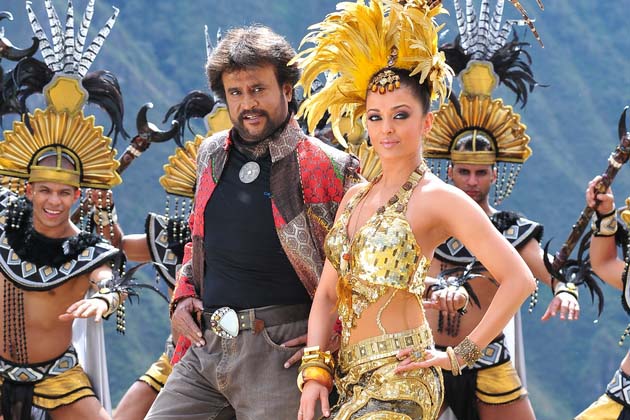
It also, however, features this scene, so all is forgiven!

The story of Ra.One is one for the XBox age: superdork Shekhar Subramanium, video game designer and husband to Sonia (the velveteen beauty Kareena Kapoor), decides it is time to do something badass enough to impress his standoffish son Prateek (Armaan Verma).  Egged on by game-head Prateek’s insistence that bad guys are the COOLEST, he designs a video game with the most powerful villain ever conceived, Ra.One.  The bulk of the film deals with Ra.One’s escape from the game environment and subsequent real world battle with Shekhar’s sleek heroic digital doppelganger, G.One.

It’s standard doofus-y whiz-bang action plotting, and the screenplay just ignores more than a few “wait, what?” moments, but no matter.  The damn thing just works.  While the first half is a little spastic in its “MUST PLEASE ALL AUDIENCE QUADRANTS” contortions, the second half tears the roof off of the place.  Director Anubhav Sinha (who has made some okay movies and some dreadful ones) keeps the pace rocketing along with confidence, and the visual elements are beyond reproach, a surprisingly smooth mix of digital and practical effects.  Two scenes in particular stand out: a frankly bonkers fight at a power station where G.One and Ra.One HURL FUCKING CARS AT EACH OTHER and a chase scene in which G.One must outrun and stop a runaway train.  The latter is the scene that most encapsulates the experience of watching Ra.One; it’s big, loud, unstoppable, fast as hell, and ludicrously, breathlessly entertaining.

The film has its very obvious mythic antecedents; Ra.One, spoken with an accent, is a homonym for Ravana, the ten-headed villain of the Ramayana.  And G.One stands in for Jeevan, meaning life.  The film plays with all of this pretty lightly, but it does give us one extraordinary scene of Ra.One strolling into a massive Ramlila and frightening the children away, backed by flames and the ten heads of Ravana.

But what of the big man?  The Shah?  King Khan?  Well, he’s the hardest working man in Bollywood.  He over-eggs the nerdiness as Shekhar, but once G.One is on the scene, Khan gives a graceful, witty, physical performance.  Kapoor, who has little to do in the pre-intermission segment but look stunning, gets to stretch her wings a little in the second half, and her chemistry with Khan is palpable.  These are two old pros just enjoying the hell out of each other, and it’s a pleasure to watch.

Kareena Kapoor looking okay, I guess

The songs are a lot of fun, too, and if they’re a little prone to the chart R and B affectations much of Bollywood has succumbed to (Akon makes an appearance and sings on two tracks), they’re well staged.  The barnstormer is Chammak Challo, in which Kapoor, sari-clad and lushly glamorous, gets to kick out the jams.

Here it is:

The secret ingredient in all of this is conviction.  Ra.One features much talk of goodness, love and heart, and though it’s never more than cliche, it’s un-ironic and sincere.  Khan believes in this picture (he’s even one of the writers), and if you surrender to its sheer immensity, you will, too.  Hail to the King.

Tamil cinema had its own Diwali spectacular this year, and the pitch was so inspired in its lunacy that I simply had to see it on a big screen (Tamil films are a little harder to find than Hindi, and this one was all the way out in Jackson Heights).  7aum Arivu arrives billed as a kung-fu sci-fi romantic thriller, and, well, the least you can say about it is that they weren’t kidding.  As ungainly in its ambitions as Ra.One is laser-focused, 7aum Arivu first caught my notice because it comes from A.R. Murugadoss, whose unofficial remake of Memento, Ghajini, is one of my favorite Bollywood experiences of the last few years (more accurately, it was Murugadoss’s Hindi remake of his own Tamil remake of Memento).  Then there was the trailer, which promised….something.

Many people call all Indian movies “Bollywood,” but this is incorrect.  Bollywood refers only to the Hindi industry, and while it’s the most visible globally, it’s hardly the only game in town.  In 2010 alone, there were releases in 24 different regional languages across India.  Tamil has the second most productive film output in the country, and if anything, it makes fewer concessions to global tastes than Bollywood.  You never forget your first hypercharged taste of it, something most people first got from another viral video of Rajinikanth, one of his signature fight scenes from the film Chandramukhi.

Potent stuff.  And not easily culturally translatable.

7aum Arivu looks at first as though it might buck the trend.  It opens with a long and gorgeous prologue detailing the journey of Bodhidarma to China, where he’s received first as a devil and then, once he’s taught them all of Tamil’s martial arts and medicine, as something like Jesus.  With its painterly cinematography, impactful action (courtesy of veteran Peter Hein), and quietly commanding performance from Suriya, it’s gripping stuff.  So of course it’s followed by about an hour of wacky modern day musical romantic comedy.  This is nothing new for anyone who’s seen a Tamil film, and the romantic track between Suriya and Shruti Hassan (the offspring of Tamil film hero Kamal Hassan) is eminently charming.

Suriya: prettier than his co-star

Summarizing the plot hardly does it justice, but it’s the story of a modern-day descendant of Bodhidarma (this is a twist, but the game is rather given away by casting the same actor in both roles) who must seize his destiny and fight off an attempt by the evil, evil, EEEEEVILLLLL Chinese to dominate and destroy India.  With his kung fu.  And hypnotism skills.
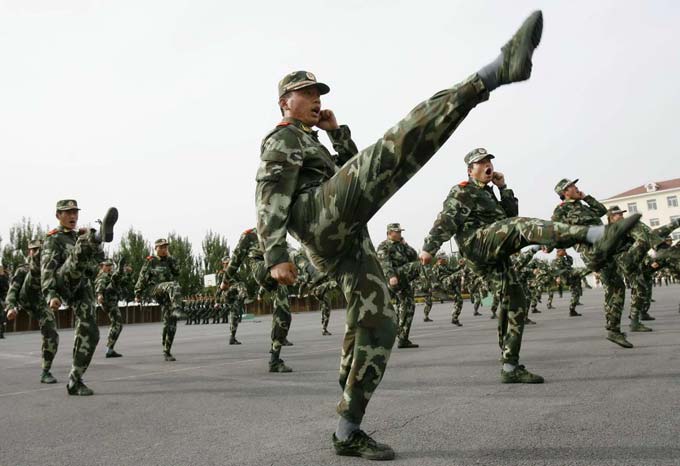
Communism, Broadway musicals....is there nothing China cannot corrupt?

It all sounds like so much more fun than it is, and if there’s less to write about here than there is in the comparatively substance-less Ra.One, it’s because 7aum Arivu, once its thriller track gets moving, deflates with alarming speed.  For every fascinating idea it introduces (the genetic inheritance of certain skills, Tamillian culture and its corporate co-opting), it undermines itself by doing something really stupid (the film’s xenophobia is alarmingly frank, and Hassan quickly turns into a bit of a drip once her true motives are revealed).  Perhaps its biggest crime is that it makes us wait until the last five minutes before our lead revives his inner Bodhidarma and kicks some ass.  The smart call would have been to do this at the intermission point, freeing up the second half to be the epic spiritual smackdown-fest it keeps promising to be.

More of this, please. Not in a gay way or anything. Okay, maybe in a gay way. But with kung fu.

This is not to say it’s devoid of entertainment value of course; that opening is almost worth the price of admission.  Suriya and Hassan have a fair amount of infectious fun together before the plot goes awry.  Johnny Tri Nguyen, the terrific Vietnamese martial arts star, nearly walks away with the film (despite having atrocious dubbed dialogue).  There’s also a setpiece involving an overturned truck, a shit-ton of crashing cars, and dozens of hypnotized attackers that nearly revives the film through its sheer face-blasting insanity.  There’s a lingering feeling of squandered potential, though, and it hangs over fully half of the film.  Murugadoss seems either unwilling or unable to fully engage with his own ideas (and he has to own it; he wrote and directed it solo).

Not to harp on it, but the anti-China sentiment here is often off-putting.  I understand national pride, and lord KNOWS China has its problems, but sending psychotic hypno-spies to Tamil-Nadu to weaken and destroy India with bio-weapons isn’t, so far, one of them.  Ra.One has a Chinese character mysteriously named Akashi, which isn’t so much culturally insensitive as it is…weird.  When one character calls him Jackie Chan, you brace for a bit of the racial burlesque that still mars a lot of Indian cinema, but actor Tom Wu responds with hilarious annoyance.  “Stop calling me Jackie Chan!  Not all Chinese are JACKIE CHAN!”  How very odd that the less serious film would be the more sensitive (bear in mind that Ra.One is also a film with a gay joke and a bunch of nut-shots).

Watching these two films together is a study in the importance of sticking the landing.  It doesn’t matter how rock-the-house terrific your opening is if your film can’t close the deal, and you can get away with a lot of loosey-goosey silliness at the outset if you bring the pain for a big finish.  It’s also a keen reminder that Indian cinema is a game of parts.  While both films are overcrowded and nutty, only one manages to draw its disparate strands together into something remotely coherent.  You can admire the mad ambition of 7aum Arivu or detest the pandering populism of Ra.One as much as you like; one’s an inert hodgepodge, and one’s a thrilling action movie.

Still, over the course of a day, I saw a superhero video game musical and a kung fu sci-fi musical.  To complain almost seems churlish.  These are two hard-working entertainers and if one finally shortfalls, it’s not for lack of trying.  And how wonderful is it that in this age of multiplex dominance, our choices are not limited to Someone Gave Mark Wahlberg a Gun and Adam Sandler Has No Respect For Your Money or Time?

Give me the subtitles and thousands of gaudily clad dancers every time.  Happy Diwali, everybody.

Posted in Uncategorized | Leave a comment

NERDERY: Climactic Edition

It’s hard to describe the joy that accompanies a REALLY FUCKING GOOD episode of Doctor Who.  Have I been shamelessly fanboy gushing for the last couple of weeks?  Certainly.  But here’s the thing: I really do believe that, week for week, Doctor Who is as good a show as television has produced in the last 20 years.  So if there’s a problem with an episode, I’ve got a great big blind spot for it.  I just tend to be thrilled that I’m seeing sci-fi fantasy television on this epic a scale, with this much romance, adventure, humor and smarts.  As I believe I’ve said on more than one occasion, Doctor Who really is the best fucking thing ever.

"Oh, now, YOU."

Occasionally, though, the show will pull off a little something extra, really kick out the jams and let fly.  I have no shame or hesitation in saying that The Wedding of River Song is in the top five New Who episodes ever, and top ten all time Who.  And it’s easily the best season finale of the Davies or Moffat run.  That’s a big claim, but Steven Moffat, that magnificent son of a bitch, has brought us here with two years of planning, given us this after that damnable mid-season break.  It’s left me jumping for joy, ready to watch not only this episode but this whole season again RIGHT NOW.  RIGHT NOW.  Hell, maybe even the previous season, in case I’ve missed something.

Why is it so good?  First of all, no war.  None.  No intergalactic villain co-op, no resurrected classic villain, no Earth left in tatters, but (and this is the clever thing) the stakes are sky-high.  The strength of New Who has always been the way it summons emotion from character, much in the manner of Buffy.  Like Buffy, like all fantasy, it’s at its weakest with some manufactured external threat that we’re told puts EXISTENCE ITSELF in peril.  These shows tend to go astray when they back themselves into a narrative corner that can only be resolved with BIG-ASS ACTION SCENES.  So Moffat keeps it simple, delivering an episode that, despite having more than its fair share of spills and thrills, feels intensely personal.

Second of all, it restores a light/dark balance that has been growing conspicuously lop-sided.  No complaints, but last week’s frothy little jaunt hardly reflected the wrenching tragedy of the weeks prior.  This time, Moffat and director Jeremy Webb hit the vintage Spielberg sweet-spot: an entertainment with a lot on its mind and heart, but one that moves with such pace and wit that all you can do is sit back and marvel and feel.

Third of all…well…everything.

The setting for much of the episode is a typically clever Moffat idea.  Since River has circumvented her destiny of killing the Doctor (a fixed point in time, meaning no-givesies-backsies), time has frozen until the error can be corrected.  It’s easy to imagine ways this might manifest onscreen, but Moffat gives us a goofy, delightful vision where time hasn’t just stopped, it’s crashed and piled up on itself until every period in human history is existing at the same time.  So we have pterodactyls in public parks (“vermin” according to signs), Winston Churchill (played again with a gruff twinkle by Ian MacNeice) serving as the Caesar of the Holy Roman Empire, steam engines that run on elevated tracks to infinity, Charles Dickens on morning chat shows….it’s an Anglophile fantasy nerd’s paradise.  But something’s wrong.  The Doctor needs to die in order for time not to simply stagnate and rot like bad fruit.  And where should we find the Doctor but Churchill’s capitol building, serving as his toga-clad soothsayer.  Churchill, having sussed out that time isn’t meant to work like this, demands answers.

"Answers. AND COGNAC. Blub blub blub."

We’re right there with him.  This season has been packed tight with riddles, puzzles, teasing hints of the bigger picture.  Of course, like Churchill, we’re fools if we expect an answer for everything.  At this point it’s pretty obvious that Moffat is the Doctor, a mad intellect leaping about his junkyard laboratory and pulling lever after lever to see what happens.  The funny thing is, the levers stay pulled, so no matter how many questions Moffat answers, there are always several more on the way.  This would be irritating if the show didn’t offer payoff, but it does.  Big time.

The biggest mystery of all is revealed, of course.  We now know the question, the one that can never be answered, lest Silence fall.  I mean, what a cheat it would be if that one was left dangling.  So, are you ready?  Have you watched the episode?  Because here comes the spoiler….

“Doctor Who?”

Moffat, you magnificent SON OF A BITCH.

It’s a piece of mischief on par with Keyser Soze, an opening-up of limitless narrative possibilities.  Also, it’s delivered by a fat blue head in a box.  Just for kicks.

River Song, naturally, is present and causing trouble.  It’s all her fault, this madness.  She won’t accept her mission, and she’s put out a call to the entire universe for help solving the problem.  In one of the episode’s many touching scenes, she explains that the Doctor needn’t have worried; nearly everyone in existence answered the call.  It’s nice to hear that after a few weeks of the Doctor being painted as history’s greatest monster.

I’ve mentioned other performances in my Who-blogging, but let’s just pause and admire the sexy, funny, devastating Alex Kingston.  She’s superb as River, selling us the one thing we never thought the Doctor would really need: a love interest.  She’s a proper Marion Ravenwood as well, resourceful, cheeky, wise and just a bit dangerous.  Tracing the meaning of her heartache and torment would take a few thousand words, but Kingston conveys it with a glance.  She’s just that good.

And so are her breasts. You may rest assured, if I had a dick pic of Matt Smith, it would be on here. Actually, I should look for one. Excuse me.

As the title makes clear, she gets married.  As you’d expect, it’s to the Doctor.  As you might not expect, at the moment they pledge themselves to each other, she finally does her duty and kills him.

Except she doesn’t.  This isn’t the Doctor, it’s a Tesselector with the Doctor inside, which would seem like a cheat if Moffat hadn’t spent so much time setting it up over the season (it’s reminiscent of the curtain-drop on Amy’s double; Moffat is nothing if not a man obsessed with pet motifs).

And so on we go.  The Doctor is free, time continues as it must, and we’re ready for more, ravenous.  There’s no magic bullet, no Tinkerbell moment as in series 3, no perfect reset for the universe.  As the show ends, the Doctor slips into the shadows, ready to continue his questing underground (does the universe and time itself have an underground?).  This time, though, for the first time ever, he has a family waiting for him.  It’s a family he brought together, a family that made him a better man.  See?  Even with time itself at stake, it all comes down to character.

There’s more, obviously.  The Silence aren’t even totally dealt with by the end.  Amy and Rory turn up, but not how you’d expect, and they both get spectacular bad-ass moments.  There’s a lovely tribute to our dear, departed Brigadier.  Nearly every strand of series continuity is touched on.  It never feels labored, never feels like the overstuffed fan service Davies delivered at his (nevertheless entertaining) worst.

This is a new model Who, sleek but junky, warm but cerebral, intense but fun.  On the evidence of this season and its smashing finale, Moffat could do this forever.  Of course he can’t, but he really does seem like a Timelord sometimes, doesn’t he?

Best fucking…oh, you know the rest.

See you at Christmas, Doctor.

Posted in Uncategorized | 1 Comment

NERDERY: Yet More Who Blogging

Some questions answered, other questions raised.  That’s more or less par for the course as we approach the end of a season with our favorite Gallifrey ex-pat.  So River is the impossible astronaut.  The Silence have succeeded in their plot against the Doctor.  And, most importantly, we finally discover where the Doctor got his cowboy hat.

"I fucking rule."

What a relief.

For an episode suffused with the dread of a coming cataclysm, Closing Time (written by Gareth Roberts and directed by Steve Hughes) has to be one of the jauntiest, most delightful hours of Who in ages.  For a start, we have the return of James Corden as Craig, last seen in The Lodger.  The Laurel and Hardy act returns, and if anything it’s better written and more beautifully timed than before.

Do not disturb their buddy comedy process. It is made of unicorns.

Corden gives a performance that can comfortably be placed in the post-Pegg-and-Wright genre world.  You know the one I mean.  Starting with Spaced and continuing through each of their collaborations thereafter, Edgar Wright and Simon Pegg specialized in placing wry, offbeat character voices within high-stakes genre storytelling (it’s the same thing that has given Who a license to be a little bit more post-modern than ever before).  The laughs never defuse the tension, they actually ramp it up.  It’s a neat trick, and it’s one that Corden has down to a science.  Craig, now a dad, is so exasperated by the demands of living in a science fiction world that his predominant response to things isn’t panic, it’s irritation.  He’s also a devoted, if easily rattled, father whose concern for his newborn son Alfie underscores everything he does.  The lovability factor is through the roof, and Craig’s tenderness drives the episode in more ways than one.

Of course, this is a double act.  And Smith is on fire this week, imbuing the Doctor, who has resigned himself to an imminent death, with a lightness of spirit and spryness of touch that we haven’t seen for a while.  It’s still our Doctor, but perhaps the inevitability of his own demise has lifted a weight rather than crushing him.  Either way, he’s an absolute scream, whether he’s offering children terrible advice about their parents’ money or talking with Craig’s baby.  In a gag that magically manages not to be insufferably cute, the Doctor has an ongoing one-sided conversation with Alfie, who makes it clear that his preferred name is Stormageddon.  Also, Stormageddon issues frequent unflattering evaluations of Craig’s parenting, which the Doctor is happy to share.  Smith plays it with his signature touch of queer, distracted vaudeville and it works.  In fact, his every line, every abstract bit of physical business, works.  It’s funny to reflect that many imagined there was no way to replace David Tennant.

The plot?  Oh, Cybermen want to invade the planet, blah blah, you know the drill.  It’s a perfectly serviceable story, but the real percentage is in the margins.  This was an episode just drenched in good humor, warmth and fun.  After a few weeks of watching the Doctor get deconstructed and broken down, this was just the ticket.  Every moment between Smith and Corden is gold, and they even manage to take what is on the page a fairly standard gay panic joke and make it sweet.  There is much talk of Craig as The Doctor’s “companion,” and they’re often forced into a close embrace.  At one point, The Doctor even tries to misdirect Craig by issuing an unambiguous gay come-on.  Does Craig freak out and start going “EEWWWWW TEH GAYZ”?  No, he does not.  He starts giggling.  And the shopkeeper who is convinced that these men are lovers doesn’t sneer; she smiles and offers discounts.  What a pleasant surprise.  And the “love conquers all” ending is resonant rather than cheesy, a real character moment and not one of the show’s many “YOU WILL CRY NOW BECAUSE IT IS REQUIRED” music-swelling crescendos.  Which I happen to like, but still.

Terrific Amy and Rory cameo, too.  Amy has become a model (or perhaps a perfume magnate, it’s unclear), and the revelation of her scent’s tagline is a bittersweet kick.

See, it’s so easy to just get lost in the details.  It’s easy to forget the darkening picture that’s still being painted.  The Doctor tosses off several mentions of his impending demise, and there’s that coda with River Song.  The image of Melody Pond, stuffed in that spacesuit and waiting in the clear waters of Lake Silencio, is bleak, haunting stuff.  Also, in case you forgot…

THE SILENCE ARE FUCKING TERRIFYING.

"Sorry, was this not supposed to be a heart-crushing nightmare? I'll get my coat."

It’s odd that the penultimate ep of Season 6 would be a standalone story, and a breezy one at that, but I appreciated that Moffat didn’t want to ratchet the pomp up to unbearable levels.  It’s gotten so that in a way I dread the season closers, because I know that every single time, the scale and stakes are going to get blown up to proportions that make last year’s model look positively ordinary.  Not so this year.  The coming confrontation is as personal as it’s ever been, one Timelord’s reckoning with mortality.

Geronimo, old boy.  Let’s see what happens.

P.S. Craig gave him the hat.  He didn’t get it for giving Wyatt Earp dating advice or something fucking stupid like that.

Posted in Uncategorized | Leave a comment

NERDERY: More Who Blogging

“I really am just a madman in a box.”

So here it is, and two episodes earlier than I thought it would be. At last, the thesis of Moffat’s run, delivered bluntly and with terrible heartbreak.

Does he mean it? I don’t know. The Doctor is an inscrutable creature, after all, capable of saying almost anything as long as it accomplishes the right end. But I think Moffat means it. Not reductively, of course: a madman in a box is still a wonderful thing and well worth watching on television. But he’s not the Messiah; he’s a very naughty boy.

You cheeky bitch.

How did it come to this? The first half of season six was about the Doctor as a resurrected, unmistakably Messianic figure. Except, of course, that it wasn’t. It’s never so simple with Moffat, who again seems single-mindedly devoted to deconstructing all of the easy comforts that Davies served up for our delectation. Oh, how we feasted on it; I even loved when little Yoda Doctor turned into big powerful Doctor because everyone believes in fairies. Hell, I swallowed the unmitigated guff of the season four finale because I wanted to believe.

"I'm sorry, Donna. But this is not hard sci-fi."

This is an entire episode devoted to tearing that faith down. It doesn’t come on like that, naturally. Writer Toby Whithouse (who gave us the enjoyable but nowhere near as complex Vampires of Venice) has brought us what can reasonably be called The Shining in Space. In a surreally old-fashioned hotel, residents are called to face what seem to be their deepest fears before falling prey to a devouring God figure. The Tardis, which apparently has the worst GPS in the galaxy, plunks down in the middle of the place and the Doctor, as is his way, decides to solve the mystery. Monster of the Week, right?

Yes. And the Monster is the Doctor.

OH SNAP.

As a title, The God Complex is a vicious fake-out. Most obviously, the minotaur inhabiting the maze is a God figure who demands worship before snuffing out his subjects. Is the Doctor so different? In a sense, he demands submission, obeisance. He tends to defy and humiliate those unimpressed with his genius. Companions can challenge him, but at the end of the day, the Doctor wins on the Doctor’s own terms. Still, even his towering, Aspergers-inflected narcissism has its limits. The “happy” ending here depends on the Doctor convincing Amy Pond that her adventures only have two possible endings: discontinuation or death. And so Whitman and Moffat do the unthinkable: two episodes before a season finale, they dump the Companion.

"What you talkin' bout, Willis?"

Seriously. The Doctor dumps Amy Pond. And poor, sweet Rory (though he does get a bitching car).

Of course, he’s still saving them. By demythologizing himself. Which only makes him more mythic and impressive.

DAMN IT.

It’s a hell of an episode, styled and shot in a manner that suggests Guillermo del Toro and Tim Burton had sex with Tron. Director Nick Hurran deserves much credit for keeping in continuity and yet layering in some deliciously baroque touches; it’s often hard to tell if the episode’s wide angles are factors of architecture or cinematography. The pace is deliberate but unrelenting, the scares wonderfully effective, and the gallows humor far more gallowsy than usual.

What really deserves examination here is that it’s an episode about the perils of religion. The obvious explanation (this monster feeds on our fears) is finally upended by the realization that the monster is REALLY feeding on faith. The last thing its victims do before dying is embrace the minotaur’s awesome divinity without question. Rory, an atheist, is safe from harm, and the Doctor remains as difficult to categorize as ever (but who or what exactly did he see behind that door…?), but everyone else has a larger philosophy to be preyed on. Paranoia, God, surrender, and in Amy’s case, the infallibility of the Doctor. They aren’t seen as weaknesses per se, but each of these worldviews is red meat for the minotaur. It cannot be a happy chance that the monster preying on these hopes and dreams is a classic false idol. Whitman’s telling us that blind devotion is a trap. It’s a pretty radical thing for a weekly family fantasy series to drop on its viewers, and more proof that Doctor Who is endlessly thematically malleable.

Terrific cast, as it happens. After last week’s 3 character tragedy, this is a proper ensemble piece. Smith is as mischievous and captivatingly intelligent as ever, with able support by the canny, haunted Gillan and the increasingly empowered Darvill. The other captives are played by Amara Karan, Dimitri Leonidas, Daniel Pirrie and comedy star David Walliams. All are good (and Walliams is particularly sharp as a ratty creature from a race of preturnatural cowards), but Karan takes the gold. She’s delightful and a natural match for our hero. The Doctor’s affections are so prized that when he takes an interest in Karan’s Muslim doctor, even the viewer feels jealous. He’s ours, after all.

Except he isn’t. He cannot belong to anyone.

Seriously, did we just lose Amy Pond? The Girl Who Waited? One of the greatest Companions the franchise has ever seen? The “NEXT TIME” teaser indicates that while the Cybermen may return, Amy Pond doesn’t. James Corden, cuddly sidekick of The Tenant, appears to be the big supporting character next week. Are we about to get a male Companion? It wouldn’t be unwelcome given Corden’s chemistry with Smith, but…

Pond?

This began as a project to just start reviewing Who for fun, but as chance would have it, the series is just starting what appears to be some of its most mature, ambitious movements to date. It’s still dynamite Saturday night entertainment, of course. But Who matters, now more than ever. It’s escapism with a conscience, adventure with consequences.

Best fucking thing ever.

Posted in Uncategorized | Leave a comment

NERDERY: My First Doctor Who Blog

This was meant to be posted Saturday night, but technical difficulties prevented it. From now on, Who blogging will be posted on the night or the next day.

Anyway.

Steven Moffat is clearly a sadist. If there is anything that gives him pleasure, and you can see it in his work with Doctor Who, Sherlock and Jekyll, it’s presenting an audience with a nearly impossible dilemma and not giving them the easy way out. There’s always a price, always a loser, and…well…not always a winner. The blueprint was set in what must be considered one of the classic Who episodes, and the first time most viewers sat up and wondered, “Who on earth WROTE this?”: The Girl in the Fireplace. The blueprint is as follows: Doctor throws himself headlong into an adventure, second party falls desperately in love, Doctor and second party crash headlong into practicalities making said love an impossibility, choice must be made to either do the thing that feels right or the thing that is right. It’s almost evil how effective a formula it is.

"And now you will cry. Yes, let me taste your DELICIOUS TEARS."

In many ways, it’s the anti-Davies. Davies loved setting in motion a thousand-car pile-up of temporal insanity and then resolving it by saying, “Well…he’s the DOCTOR!” What makes Moffat an often-divisive figure among the Who fanbase is that any wish-fulfillment is hard-earned. Look at his portrait of Van Gogh (an underrated episode if ever there was one). Even written by professional fluffer Richard Curtis, the episode ends on a hard truth: want to take Van Gogh into the future and show him how much joy his work brings the masses? Terrific. He’ll still kill himself, but his life will have one more tiny, infinitesimal increment of joy in it. The big finish to Moffat’s first season? A massive, euphoric happy ending tempered only by the knowledge that Rory waited all alone for Amy for thousands of years, and the Doctor was imprisoned in a claustrophobic space-box for the same length of time. Take the win where you can find it, Moffat seems to be saying, and decide if it was worth it.

(By the way, this episode was written by New Who veteran Tom MacCrae, but it is DRIPPING with the Moffat house style)

All of this is by way of saying that the tenth installment of the 6th season, The Girl Who Waited, is one of the most emotionally grueling Who episodes in recent memory, and one of the best. Moffat’s been on a dream run, building an entire season around the twin intricacies of River Song’s origin and the Doctor’s growing reputation as an intergalactic menace. In fact, Moffat may be the first writer to devote this much time to debunking the myth of the Doctor as some charming, shambling intergalactic hobo (despite the lovely shades of Troughton that Matt Smith colors into his portrayal) who brings a bit of sunshine and danger into the lives of his fellow travelers. This season, it’s been made clear: the Doctor has fucked up. A lot. And the cost has never been more apparent. The River Song origin story has tied into this quite neatly. After all, what sort of man is so horrifically dangerous that an alien society breeds a weapon to get rid of him?

THIS GUY

All of this makes it sound like this episode is not also packed with AWESOMENESS, which it most assuredly is.

Let’s back up.

The story: the Doctor takes Rory and Amy to the planet Apalapucia, one of the top tourist attractions in the universe (not the top one, the Doctor explains, because “everyone goes there”), only to find that the Tardis has landed in a “kindness facility” designed to quarantine and treat victims of the Chen 7 virus. Amy is separated from the group and, having been mistaken for a virus victim, placed in an alternate, and much accelerated, timestream. She grows old in a matter of minutes. The rest of the episode is about Rory and the Doctor attempting to rescue her.

Except that it’s really about so much more. Amy, by the time Rory and the Doctor find her, has spent nearly 40 years as the only sentient being in a facility full of robots who unwittingly try to murder her with alien vaccines her body won’t accept. She’s old, she’s tired and she’s bitter. For the first time, she truly hates the Doctor.

And you know what? Maybe she ought to hate him. Amy’s first exposure to everyone’s favorite Time Lord was based on a betrayal: he dangled the promise of adventure right in front of her eyes and then vanished for years. This time, however unintentionally, the Doctor has left her out to dry in the worst way possible. Her youth has been drained away, her sense of adventure hardened into a grim survivalism. The Doctor, through his capricious noodling, has essentially killed Amy Pond.

Of course there’s a way out. Through the usual “timey-wimey” thingamajigging, it is possible to rescue young Amy and thus erase old Amy. Old Amy, however, may have survived too long to submit to that very easily.

Okay, this is complicated.

If there’s a star this week, it’s not Matt Smith, who spends most of the show in his own little bottle episode entitled I Fucked Up, trying to fix his errors from inside the Tardis. Nor is it Karen Gillan, who gives her usual sterling performance and ages herself smartly. No, this week belonged to Arthur Darvill. Rory has, over the course of the Moffat run, established himself as one of the first “boyfriend companions” to not immediately make me break out in hives from irritation. Starting off as a bit of a drippy smart-alec, Rory has revealed himself to be a courageous, intelligent and challenging match for Amy. In other words, a totally reasonable alternative to the Doctor. I never spent hours wondering if Rose would ditch her kick-ass adventures around space and time to settle down with poor, butt-hurt Mickey. Even Davies seemed to know that, eventually finding an excuse to make Mickey bad-ass, by which point we’d all forgotten about him anyway. No, Rory is key to the success of the current series, and Darvill’s been given a lot to play in this episode.

He rises to the occasion, to say the least. Darvill’s usual “JESUS CHRIST WHAT HAVE YOU DONE” panic plays beautifully as he searches for young Amy, but when he finds old Amy, it turns into something else. We see that he would take old Amy if he had to, but when the great big honking Sophie’s Choice at the heart of the episode shows up, Darvill’s performance goes from sweet to heart-rending. The climactic minutes of The Girl Who Waited are almost impossibly moving, and it’s all down to Darvill. He’s earned his spot in the opening credits, no mistake.

Just one of the many faces of Arthur Darvill

BUT HOLY SHIT, KEITH, THAT SOUNDS SO DEPRESSING.

And it really would be, but the episode is packed tight with just the sort of nimble thrills that Who delivers at its best. It’s lightspeed storytelling, throwing loops and curves at regular intervals, and steeped in the kind of talk-as-action that makes me think Moffat may actually be the science-fiction Aaron Sorkin. But it’s not all wordplay and puzzle-cracking. Amy Pond gets a sword. Think about that for a second. Ever thought it might be fun to watch Amy Pond slice through a battalion of robots with a samurai sword? Turns out you were right. Another sweet little kick: Imelda Staunton is the pleasantly unhelpful voice of the facility. Apparently Umbridge has found work in alien healthcare.

ALSO THERE IS A SWORD

The design may also be a new high for Who. The sterile, blindingly white facility and the vast alien topiary are lushly envisioned. For action, pace and visuals, director Nick Hurran deserves top marks. This is spectacularly confident television.

It all comes back to this, however: how long can this last? There’s no real comfort in the closing lines of The Girl Who Waited. The Doctor is still on the run. Amy’s been to hell and back several times over. Rory has displayed more patience than any boyfriend in the history of the world. There’s a reckoning coming, and one more clearly defined than any threat in the post-Davies era. Is the Doctor going to have to pay? And how dearly?

Of course he’ll make it through. Just. But there will be a price.

Doctor Who really is the best fucking thing ever.

Posted in Uncategorized | Leave a comment